Blog / Driver Safety

Blog

All Driver Safety Lincoln dealership Lincoln Nautilus Lincoln Aviator Lincoln Navigator Montgomery Lincoln Dealer Lincoln Corsair Local Lincoln Service Montgomery Lincoln Service Lincoln Certified Pre-Owned Stivers Lincoln Alabama Service Lincoln Model L100 Concept
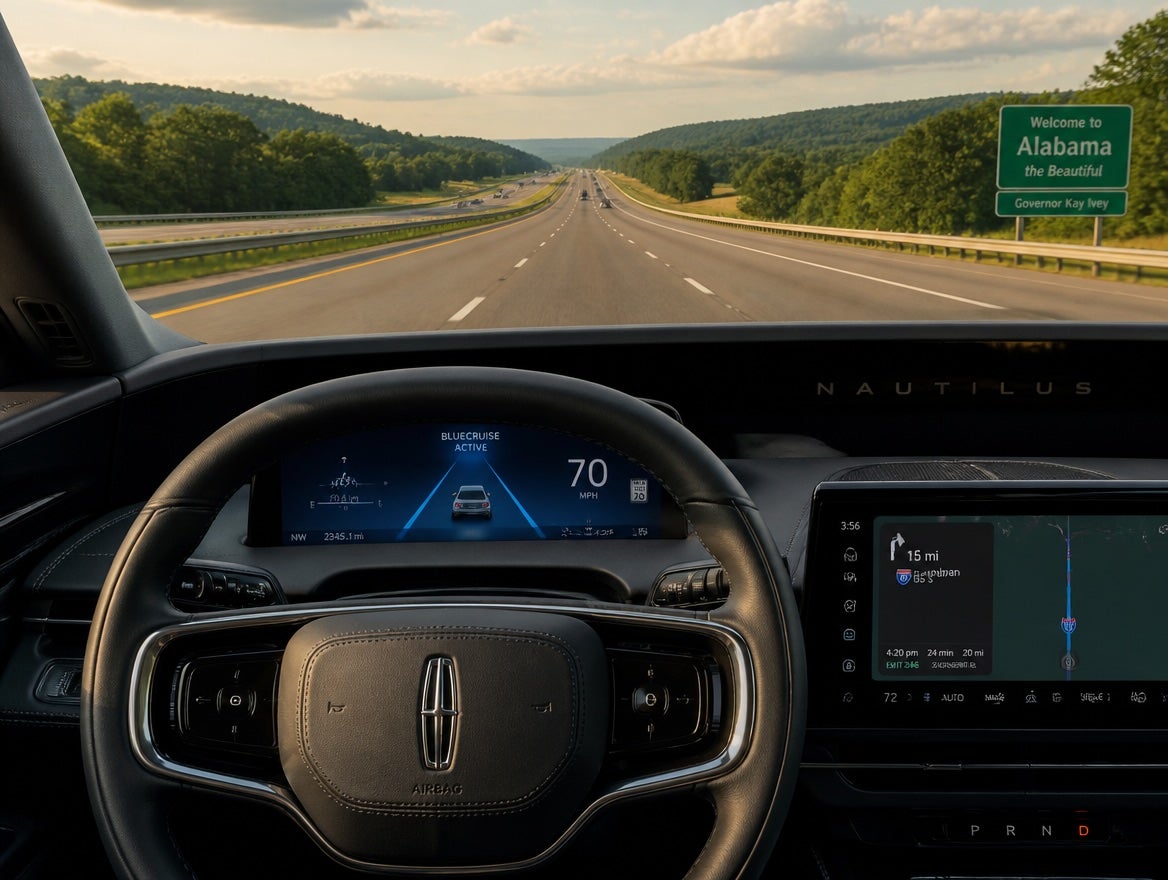
2026 Lincoln Nautilus on an Alabama interstate with BlueCruise hands-free mode active in the instrument cluster

Lincoln BlueCruise vs. Adaptive Cruise Control: What Alabama Drivers Should Know

In this article What's the Real Difference Between BlueCruise and Adaptive Cruise Control? Does BlueCruise Actually Work on the Highways I Drive Every Day? The Subscription Layer: An Honest Look at What It Costs After the Trial The Driver Monitoring System: Eyes On, Always So Which Should You Actually Choose? If you're interested in a new Lincoln, you've probably come across the terms BlueCruise and Adaptive Cruise Control when reading about driver-assistance systems. These aren't one and the same, nor are they two different systems fighting over the same job. BlueCruise builds upon and elevates the basic principles of Adaptive Cruise Control, and once you see that relationship clearly, you understand when each layer is working and why it matters on the interstates you actually drive. The short version Adaptive Cruise Control (ACC) is standard on every 2026 Lincoln. It manages your speed and following distance, including full stop-and-go, on any road. BlueCruise layers hands-free steering onto ACC within pre-mapped divided highways called Blue Zones, covering 97% of controlled-access highways in the U.S. and Canada, per Lincoln. On I-65 and I-85 out of Montgomery, BlueCruise engages automatically when conditions qualify. It does not work in construction zones, when lane markings are unclear, or while towing. The 2026 Nautilus and Aviator ship with BlueCruise 1.5, which adds Automatic Lane Change. The Navigator ships with BlueCruise 1.4, which adds enhanced curve stability. Both systems require an attentive driver. Neither is autonomous driving. What's the Real Difference Between BlueCruise and Adaptive Cruise Control? Adaptive Cruise Control handles the gas and the brake inputs on any road, and BlueCruise adds the steering on top of that within specific pre-mapped highway zones. As such, the two features aren't competitors but layers of one stack, which is the cleanest way we've learned to frame it for anyone standing on our showroom floor. Lincoln's own technology stack mirrors that hierarchy exactly. BlueCruise builds upon Adaptive Cruise Control and Lane Centering Assist to provide hands-free highway driving capability. You don't choose between them. ACC is always active when you engage cruise on any road; BlueCruise is the additional layer that appears on qualifying divided highways and lets you rest your hands. The 2026 lineup breaks down as follows, confirmed from Lincoln's published specification tables. Feature Adaptive Cruise Control 2.0 BlueCruise (2026) Speed + following distance management Yes, all roads Yes, within Blue Zones Stop-and-Go in traffic Yes Yes (inherited from ACC) Lane Centering Assist Yes Yes (required foundation) Hands-free steering No. Hands on wheel required Yes, inside Hands-Free Blue Zones Lane Change Assist (tap signal) No Yes (v1.5 Nautilus, Aviator) Automatic Lane Change No Yes (v1.5 Nautilus, Aviator) Enhanced curve speed management No Yes (v1.4 Navigator, v1.5 all) Works while towing ACC: yes BlueCruise: no Subscription required No Yes, after included trial/plan

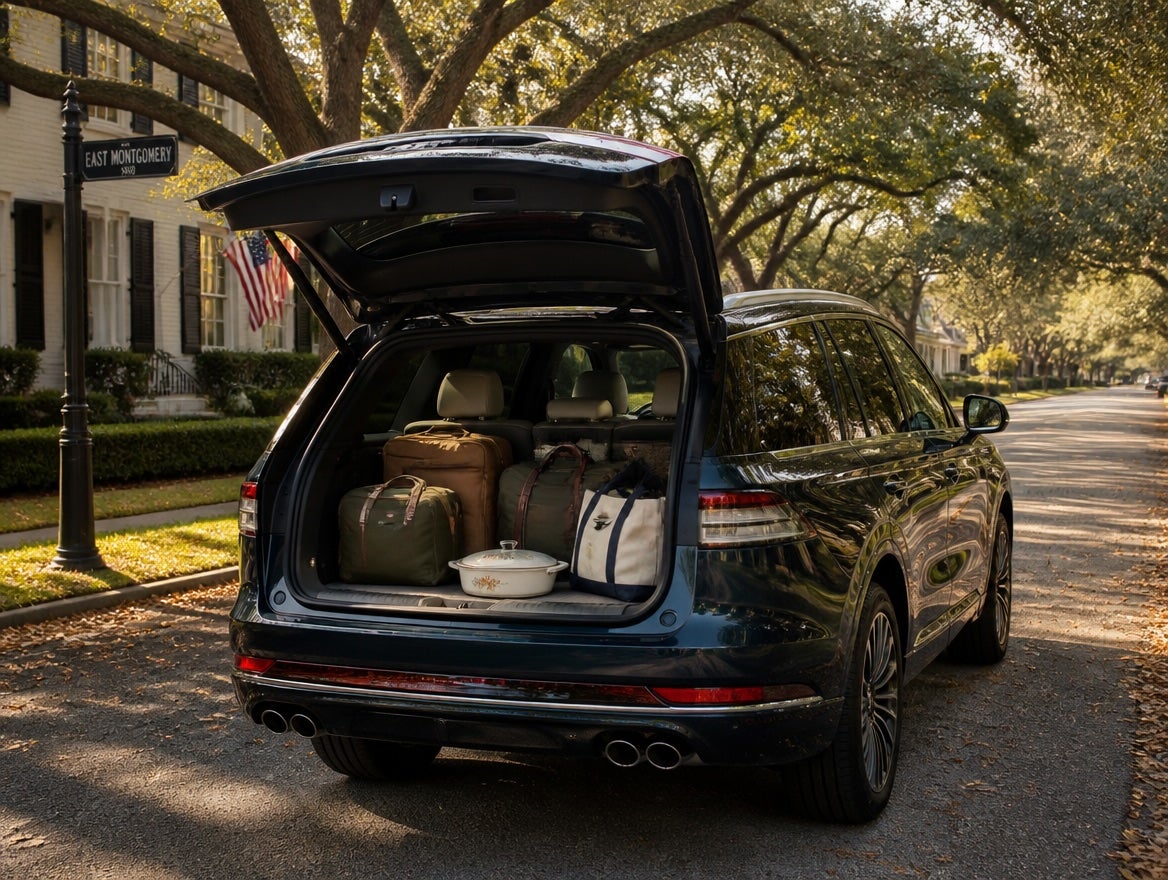
A 2026 Lincoln Aviator in a deep metallic color loaded for a holiday trip, liftgate open and cargo area neatly arranged with soft duffels and a covered casserole dish, parked on a quiet east Montgomery residential street framed by mature live oaks in late-October light

Pack a Lincoln Aviator for Thanksgiving Travel from Montgomery

The 2026 Lincoln Aviator handles a full Thanksgiving trip out of Montgomery without compromise, as long as you make one deliberate choice before loading. With the third-row seats up, Aviator provides room for up to seven passengers and 16.5 cubic feet behind them. Third row folded gives you five passengers and nearly 40 cubic feet of flat cargo floor. That single decision shapes everything else you load, and it's far easier to get right before you've touched a bag. Which Seat Configuration Actually Works for Thanksgiving? The answer depends on who's riding, not just how many bags you own. Lincoln lists cargo volume on the 2026 Aviator at 16.5 cubic feet behind the third row with all seats up, 39.9 cubic feet with the third row folded flat, and 75.9 cubic feet with both rear rows down. Those numbers carry real weight once you're loading holiday luggage for a multi-generational household. Scenario Seat Config Cargo Volume What Fits Comfortably The Tradeoff 5 passengers + full luggage Third row folded 39.9 cu ft Four full-size soft duffels, a cooler, casserole carrier, two backpacks Grandma and Grandpa travel in genuine comfort 7 passengers + light bags All rows up 16.5 cu ft Soft bags only: 3-4 small duffels, a backpack, one flat dish carrier No hard-sided suitcases; pack light or ship ahead 2 passengers + maximum cargo Both rear rows down 75.9 cu ft Full folding table, multiple bins, large soft-sided luggage More cargo than any holiday trip realistically needs 6 passengers + moderate luggage Third row up, row 2 captain's chairs 16.5 cu ft Works best with soft bags and roof-level expectations Third-row adult legroom is 29.2 inches; fine for teenagers, snug for adults Browse our current Aviator inventory to see which seat and trim configurations are available right now. The 39.9 cubic foot setup with five adults is what our team sees working most comfortably for a multi-day trip. The floor is genuinely flat once the PowerFold third row drops, so there's no awkward step or angle to load around. Hard-sided rolling suitcases fit with the utmost of ease. What Do the Cabin and Tech Features Do for a Long Holiday Drive? I-65 north toward Birmingham and I-85 northeast toward Auburn and Atlanta are Montgomery's two primary Thanksgiving departure corridors, and both are long, open stretches of highway where the Aviator's touring character earns its keep. Every 2026 Aviator includes a four-year BlueCruise 1.5 subscription as a standard feature. On pre-mapped highway sections, the system manages steering, speed, and lane positioning while an in-cabin camera monitors driver attentiveness. It's an aid that still needs an alert driver, not a substitute for one. That distinction matters, and it's worth understanding before you settle in for the return-Sunday traffic. The 3.0-liter twin-turbocharged V-6 makes 400 horsepower and 415 pound-feet of torque, and the adaptive suspension is standard on every trim. It soaks up highway expansion joints without fuss. You feel that calm with a three-year-old in row two and a grandmother in row three. For most Montgomery households heading to the in-laws in Atlanta or Auburn, the Aviator is the right size. Seven adults on a long haul is a squeeze. No packing trick fixes it. The decisive question is not whether the Aviator fits the holiday trip. It is whether you are traveling five or seven passengers, because that single variable determines which cargo floor you load. Packing note from our team: Soft-sided duffels compress and stack; hard-sided rollers don't. If you're keeping the third row up for seven passengers, tell everyone who's packing before the bags reach the door. A 28-inch hard-shell suitcase won't fit behind an occupied third row with room left for anything else. Pack the same trip in soft bags and it works without drama. What Should You Do Before Leaving the Driveway? A quick once-over before a holiday drive earns back the fifteen minutes it costs. November sits inside Alabama's secondary severe-weather season, and the state's climate runs warmer than most relatives up north expect, but the weather can still turn. Tire pressure tends to drift in temperature swings, and the Aviator's tire-pressure monitoring system will flag a meaningful deviation, though not a borderline one. The 2026 Aviator's standard Lincoln Co-Pilot360 2.1 suite includes Pre-Collision Assist with Automatic Emergency Braking, Blind Spot Information System, and Lane-Keeping System. They run quietly in the background. Make sure every second- and third-row passenger knows where the rear climate controls and USB-C charging ports are before you pull away from Eastern Boulevard. Hunting for a charging cable in I-65 traffic is nobody's best moment. If the Aviator needs a pre-trip fluid check or tire rotation before the holiday, schedule service with our team before demand fills the bay through the Thanksgiving week. Schedule a Pre-Trip Service Check Frequently Asked Questions Does the third row of the 2026 Lincoln Aviator have enough room for adults on a long trip? The 2026 Aviator's third row measures 29.2 inches of legroom and 36.9 inches of headroom. It is a reasonable fit for teenagers and younger children on a several-hour drive. For adult relatives on a trip longer than two hours, it is worth being candid: the third row is compact by adult standards. Families who regularly carry seven adults on long trips may find the Navigator L worth a conversation. Can you fit hard-sided luggage in the Aviator with the third row up? Not comfortably. Lincoln lists 16.5 cubic feet behind the third row when all seats are occupied. Hard-sided rollers in the 24-to-28-inch range do not stand upright in that space. If the full third row will be used, we recommend soft-sided duffels, a flat dish carrier, and anything that can be tucked under second-row seats. Fold the third row and the cargo floor opens to 39.9 cubic feet, which handles most rolling luggage without issue. Does the 2026 Lincoln Aviator include BlueCruise for highway driving? Yes. Lincoln includes a four-year BlueCruise 1.5 subscription on every 2026 Aviator trim, from Premiere through Black Label. On pre-mapped highway stretches, the system can hold the lane and manage following distance hands-free while monitoring driver attentiveness. It is designed as a driver-assistance feature, not as an autonomous system, and attentiveness is still required at all times. Value Your Trade Before the Holidays Stivers Lincoln of Montgomery 4000 Eastern Blvd, Montgomery, AL 36116 (334) 647-6905

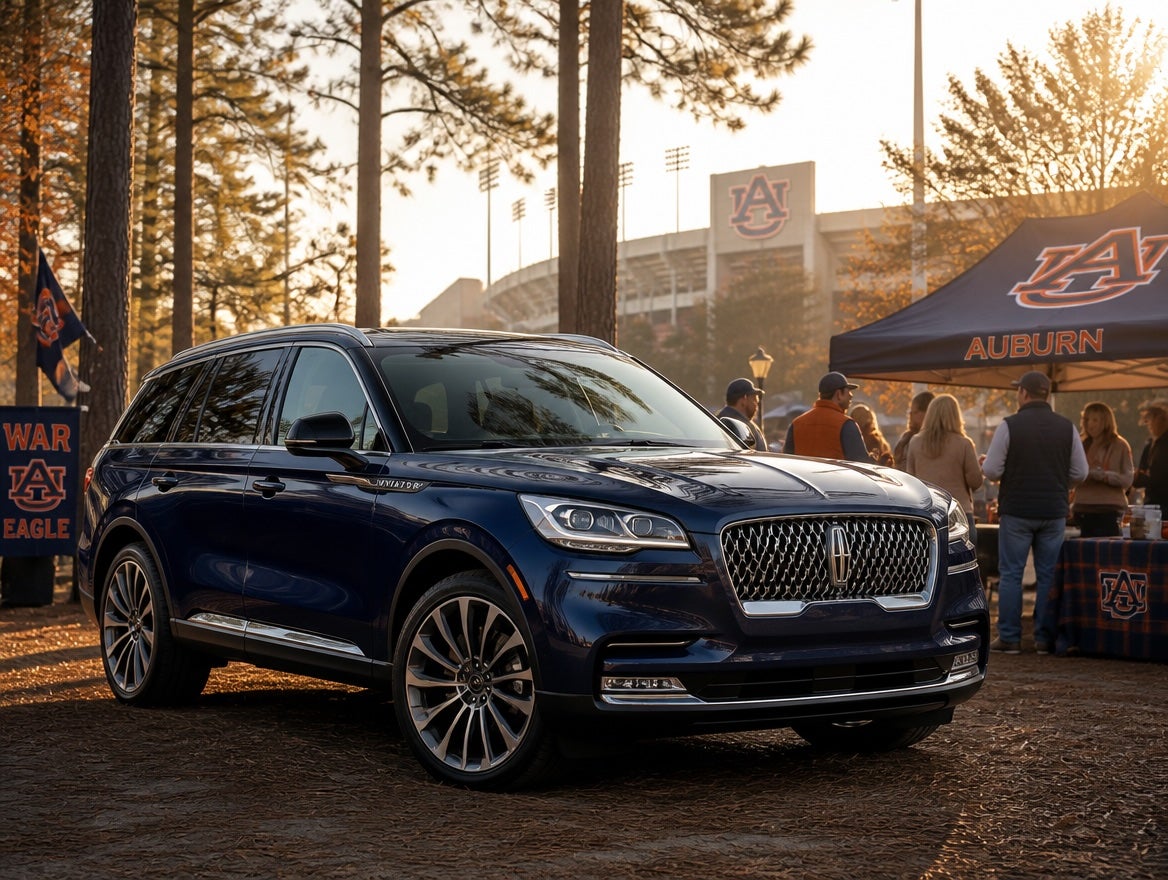
2026 Lincoln Aviator parked at an Auburn game-day tailgate area near I-85, Alabama, warm September afternoon light

Preparing Your Lincoln for Game-Day Traffic on I-85

The drive from Montgomery on an Auburn game day runs only about 54 miles. Fifty-four miles that can swell into a two-hour slog if you leave at the wrong time and wing the return with no plan. We've watched it play out from the lot on Eastern Boulevard, since folks stop in the day after a night game looking more worn down than when they left. So here's the plan we'd give a friend, a time-anchored four-stop itinerary that leans on what your 2026 Lincoln Aviator or Navigator does well on a divided-highway run in early-November Alabama. The route is I-85 North the whole way. No shortcuts, no back roads on game day. The plan lives in the timing. What Does the Route Actually Look Like? The route below is the skeleton of the day, and it holds up because every stop is real and every drive time is a normal-traffic baseline, with the game-day minutes folded into the timing notes rather than the raw figures. Read it once before you load, and you'll leave nothing to chance. Stop Depart Drive Time What You're Doing What to Have Ready Eastern Blvd, Montgomery 9:00 AM Start here Load up, climate set Cooler, stadium bag, BlueCruise on Eastchase area (fuel/coffee) 9:15 AM ~15 min Last fuel stop before Auburn Top off the tank Auburn tailgate zone 10:00 AM ~45 min Arrive pre-crowd, park early Parking pass, chairs, cooler Post-game hold (Auburn) ~4:30 PM After final whistle Wait out the Exit 51 backup Snacks, chargers, rear climate Montgomery (home) ~6:00 PM ~55 min I-85 clears fast once it moves Nothing left to do That 9:00 AM departure is not arbitrary. I-85 sees a major spike in traffic before and after kickoff, with fans traveling from Montgomery and beyond flooding the exits and creating backups at key interchanges. Getting into Auburn by 10:00 AM means you're settled before that wave builds. The post-game hold (Stop 4) is the move most people refuse to make and then regret. The Four Stops, In Order Stop 1: Eastern Boulevard, Montgomery - Load and Leave by 9:00 AM Start cold, because Alabama in November is starting to turn cool. Your Lincoln knows it. Before anyone climbs in, set the cabin temperature and run the ventilated or heated seats so the leather sits at the right temperature by the time you reach the ramp. Call it a detail rather than a luxury quirk, the thing that makes a 7:00 PM kickoff trip feel different from the same drive in a lesser cabin. A team observation is worth sharing here. The I-85 on-ramp from the east side of Montgomery behaves differently than it looks on a map. Give yourself the full 9:00 AM departure window, not 9:15. The 2026 Navigator seats up to eight. If your crew fills it, the rear-zone climate control matters as much as the front settings on a November morning. Schedule a Pre-Trip Service Check Stop 2: Eastchase Area - Fuel and Coffee, Around 9:15 AM We build this stop in rather than leaving it to chance, because fuel stations near Exit 51 in Auburn get genuinely congested on game day, and you don't want to be circling for a pump with a full load of passengers and a parking clock ticking. Fuel stations are abundant near the I-85 exits around Opelika, but Eastchase on the Montgomery end is faster and calmer at 9:15 AM than anything east of Shorter. Top off here even if you don't strictly need to. Those 15 minutes you're glad you spent. Stop 3: Auburn Tailgate Zone - Target Arrival by 10:00 AM Exit 51 onto South College Street is the main interchange for downtown Auburn and the university, and the first place game-day traffic backs up. Arriving before 10:00 AM puts you ahead of the main wave. Each game-day parking pass issued through Auburn University now includes a QR code with a map and prescribed route from each parking area to either Interstate 85 or Highway 280. Download that route before you leave Montgomery. Entering it into the Lincoln's navigation system before you pull off I-85 means you're not fumbling with directions on South College Street when traffic is dense and the pavement is narrow. The 2026 Aviator's twin-turbocharged 3.0-liter V6 produces 383 horsepower according to Lincoln, but the spec that matters here is not the horsepower number. What matters is that the powertrain runs quietly enough that passengers in the third row can hold a conversation at highway speed without raising their voices. The 2026 Lincoln Aviator carries NHTSA 5-Star Crash Safety Ratings (for the 2025 model), and the structural build that earns those ratings is the same mass that gives the cabin its low road noise. Timing note: November Auburn home games often kick off in late afternoon or evening. The crowd arriving from Atlanta peaks I-85 at Exit 51 roughly 90 minutes before kickoff. Being parked and set up before that window is the whole game. Stop 4: The Post-Game Hold - 4:30 PM Until the Road Clears Stop 4 is where the itinerary earns its keep, so do not leave immediately after the final whistle. Sit tight. A home game brings tens of thousands to a college town, and the city runs an involved post-game one-way scheme to clear them. That scheme takes time. The I-85 on-ramp backs up from Exit 51 down into the interchange for 30 to 45 minutes after a sold-out game. Sitting in that queue with a full cabin in November can costs you more time than simply waiting it out in a parking area. The Lincoln is built for exactly this kind of wait, so rear passengers stay comfortable, the panoramic display keeps everyone connected, and no one is climbing over each other. Unhurried by design, it's a fair test the parking lot happens to provide. For families with children, the Aviator's third row carries its own climate zone. Call it more than a footnote. What it does is make the hold tolerable. [ ] Set rear climate to a lower temperature 10 minutes before departure [ ] Confirm fuel level (you topped off at Stop 2, so you're fine) [ ] Check ALGO Traffic or Waze for real-time Exit 51 conditions before pulling out [ ] Navigate to I-85 South using the saved route rather than recalculating in traffic [ ] Distribute any remaining snacks or drinks before the on-ramp Tweak It to Your Crew Not every crew runs four people and a cooler, so the plan flexes with your configuration, whether you're hauling a full family with stadium gear or making the run two-up with fuel economy on your mind. The vehicle you pick changes which part of the itinerary gets easier. If you're bringing the full family (seven or eight passengers), the Navigator L is the vehicle that makes the itinerary work without compromise. The Navigator can seat eight people and, in extended wheelbase form, has a cargo capacity of 121.6 cubic feet behind the first row. That means the stadium gear, the cooler, and the folding chairs fit without a cargo carrier on the roof. If it's two of you and fuel economy is on your mind, the Nautilus hybrid is worth knowing about. Lincoln's official figures put the Nautilus hybrid at an EPA-estimated 30 combined MPG with 285 combined horsepower. A 110-mile round trip in September heat is a perfectly reasonable use case for that powertrain. For any vehicle in the lineup, BlueCruise is the feature that changes what the I-85 run feels like. Lincoln BlueCruise operates on 97% of controlled-access highways across the U.S. and Canada. I-85 between Montgomery and Auburn is a divided controlled-access interstate. On qualifying sections, BlueCruise manages acceleration, braking, and lane centering while a driver-facing camera confirms your attention stays on the road. It's a driver-assistance aid, not an autonomous system. Your hands come off the wheel; your eyes and judgment do not. But on a 54-mile freeway run with steady traffic, that distinction matters less than the drop in fatigue it delivers on the return trip. One honest tradeoff is worth naming. A sold-out Auburn home game draws a crowd that can blow this schedule apart. The itinerary above is built on normal-traffic baselines. A night game, a rivalry matchup, or a major ESPN broadcast can push all of those times 20 to 30 minutes in either direction. The Lincoln holds its composure in stopped traffic better than most. The itinerary is the plan. Composure is the fallback. Value Your Current Vehicle Stivers Lincoln of Montgomery 4000 Eastern Blvd, Montgomery, AL 36116 (334) 647-6905

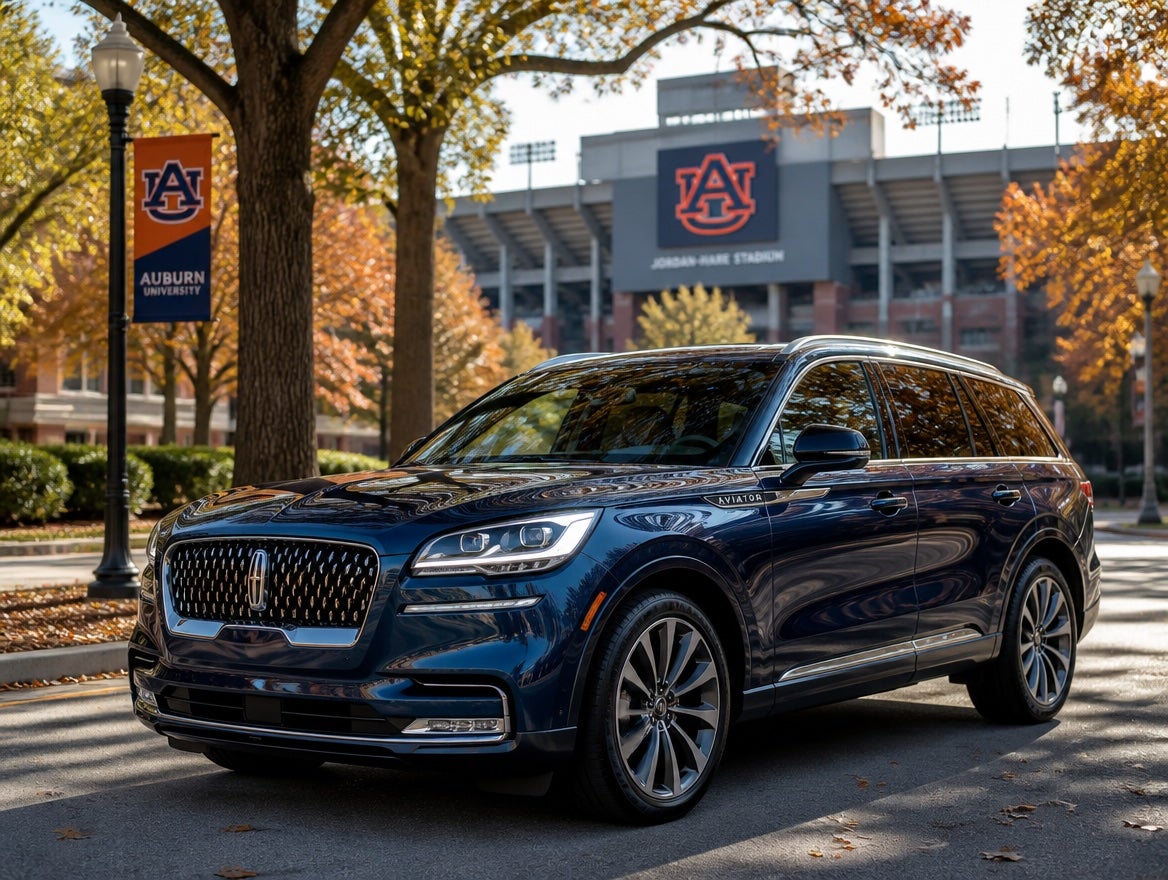
2026 Lincoln Aviator parked near Jordan-Hare Stadium on Auburn University campus on a September game day

Driving From Montgomery to Auburn for Game Day in a Lincoln

In this article What's the Plan at a Glance? Toomer's Corner and the Approach to The Plains The I-85 Stretch: Where the Lincoln Does Its Thing How the Vehicle Fits the Day Take I-85 North for 54 miles, arrive in roughly 55 minutes on a clear morning, and you've got one of the more satisfying short drives in the state. That's the plan. What makes it work is deciding, before you leave, whether you need the Aviator's composed three-row cabin for the family or the Navigator's full-flagship presence for a larger crew, then treating the parking reality at Jordan-Hare as part of the strategy from the start. Central Alabama means heat. Real heat. The kind that turns an unprepared cabin into a sauna the moment you crack the tailgate at a parking lot on Donahue Drive. We see clients load up for Auburn games, and the ones who arrive settled, cool, and ready to enjoy themselves are almost always in a vehicle that was managing the environment before they even left Montgomery. For most groups, The Lincoln Aviator fits that description. Three rows, a cabin that genuinely quiets road noise on I-85, and enough room behind the third row to carry coolers, chairs, and gear without asking anyone to hold something on a lap. What's the Plan at a Glance? Stop What to Do Best Time Parking Note Stivers Lincoln, Eastern Blvd, Montgomery Confirm vehicle is prepped; fuel, tire pressure, cabin cool Morning of game Your own lot I-85 North to Exit 51 (Auburn) 54-mile drive; BlueCruise active on qualifying stretch Allow 60-75 min game day N/A Toomer's Corner, Auburn Coffee, a walk through town, the pre-game atmosphere 3-4 hours before kickoff Street and garage parking within walking distance Jordan-Hare Stadium area Tailgate (free lots at Hayfields and Community Gardens) or ticketed lot Lots open before kickoff Large SUVs: pre-purchase a reserved spot; free lots are first-come Jordan-Hare Stadium Kickoff (88,043-seat capacity) Per your ticket Walk from parking area Toomer's Corner and the Approach to The Plains Auburn's downtown on game day is worth arriving early for, because the walk into the pregame crowd with coffee in hand is half the reason you make the drive, and getting there with two hours to spare beats the frantic parking-lot sprint every time. Toomer's Corner sits at the intersection of College Street and Magnolia Avenue. Fans gather there well before kickoff, and the energy at that hour has almost nothing in common with the scramble that comes later. The Lincoln Navigator earns its keep on a longer group trip to Auburn or a longer SEC road game later in the season. For Toomer's Corner and the immediate campus area, though, the Aviator's narrower footprint is easier to place in a downtown garage or along a tree-lined residential street. We'll say the tradeoff plainly. The Navigator is the right call when you're hosting six adults in real rear-seat comfort, or when the trip includes luggage for an overnight, and it's a larger vehicle to park, so you plan for it. Local note: Free tailgate lots at Hayfields and along Community Gardens open on a first-come basis on Saturdays. They fill up. Arriving three to four hours before kickoff is not excessive. It is standard practice at Jordan-Hare, and it turns parking from a problem into part of the day. The I-85 Stretch: Where the Lincoln Does Its Thing Fifty-four miles on I-85 North isn't a stress-inducing drive in any vehicle, but in an Aviator or Navigator it turns into something closer to restful, largely because Lincoln lists BlueCruise 1.5 as standard on all 2026 Aviator trims (not available on upper trims only, across the whole lineup). The system operates on prequalified hands-free Blue Zones across qualifying sections of I-85, which means a meaningful portion of the Montgomery-to-Auburn run qualifies. The driver still needs to be attentive and ready to resume control at any moment (BlueCruise is a driver-assist feature, not an autonomous system). Even so, the reduction in sustained physical input on a 55-minute interstate leg is noticeable. A Navigator L raises that comfort level further with its long-wheelbase body, an additional 11 inches of length and 14.5 cubic feet of extra cargo capacity behind the third row (relevant if you're packing a serious tailgate setup with chairs, a canopy, and a cooler). The 2026 Navigator's twin-turbo 3.5L V6 produces 440 horsepower and 510 lb-ft of torque per Lincoln's published specs, and all of that is managed through a 10-speed automatic with standard 4WD. You're not working the engine hard on I-85; it's simply there when the merge demands it. The honest note on the Navigator for this particular trip has to do with thirst. The EPA rates the 2026 Navigator at 15 city / 22 highway / 17 combined MPG (4WD, all trims). On a 54-mile primarily highway run, you're in the more favorable end of that range. It is not an efficient vehicle in any objective sense, and that's a real cost worth saying out loud. For a group of five or more who want the full flagship experience on the way to The Plains, it's also a deliberate choice. Next step: If you haven't driven an Aviator or Navigator on the interstate yet, we'd suggest doing it before game day. A quick run down Eastern Boulevard onto I-85 gives you a real sense of how BlueCruise settles the cabin on a highway stretch. Schedule a Pre-Trip Service Check How the Vehicle Fits the Day The 2026 Aviator's twin-turbo 3.0L V6 produces 400 horsepower and 415 lb-ft of torque per Lincoln's published specifications, and that figure barely registers at a steady I-85 pace, though it does show up in the merge off the Eastern Boulevard on-ramp and in the way the cabin manages noise and isolation at interstate speeds. Lincoln rates the Aviator at 17 city / 25 highway / 21 combined MPG (EPA estimates, front-wheel drive; AWD figures differ slightly). On a 54-mile highway run, the math is comfortable. Which one actually makes the trip? For most families it's the Aviator, so Browse our current Aviator and Navigator inventory at Stivers Lincoln before you commit and let the tailgate decide. Cargo volume with all three rows folded flat is 77.7 cubic feet in the Aviator per Lincoln's listed specs (enough for chairs, a soft cooler, and the gear that makes a two-hour tailgate genuinely comfortable). The 30-way Perfect Position front seats with available ventilation take September heat seriously. That last detail matters more than it sounds when you've just walked across a sun-baked parking lot and need to cool down before you even reach your seat. It matters. The drive home after a game (night, tired, likely a slower pace) is where the cabin's quiet pays its second dividend. Sixty minutes on I-85 South goes by differently when the road noise is managed and the seats haven't worn you out. The Plains will do the rest. Our job is making sure you arrive at Toomer's Corner composed enough to enjoy it. See What Your Current Vehicle Is Worth Stivers Lincoln of Montgomery 4000 Eastern Blvd, Montgomery, AL 36116 (334) 647-6905

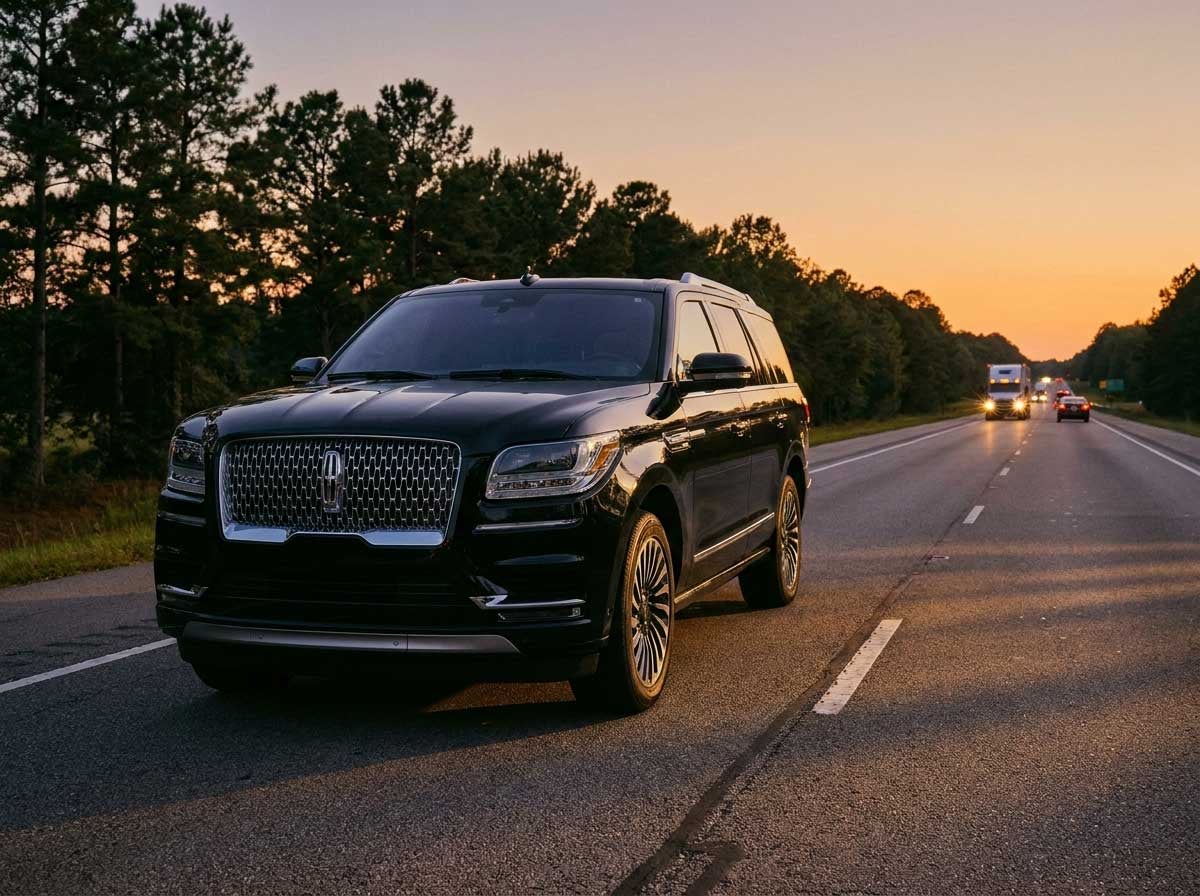
2026 Lincoln Navigator on I-65 in Alabama during game-day traffic at sunset

Preparing Your Lincoln for Game-Day Traffic on I-65

On any Alabama football Saturday, I-65 north of Montgomery turns into something between a highway and a slow-moving parade. The run from the River Region to Bryant-Denny Stadium in Tuscaloosa covers about 90 miles, and the traffic sorts itself into three phases you can't miss. First there's a congested push through the Montgomery interchange, then a reasonably open mid-highway stretch, then a tightening crawl as Tuscaloosa gets close. Each phase leans on a different set of systems in your Lincoln, and knowing which one does what tells you plenty about which vehicle actually fits your Saturday. Here's the short answer. Lincoln's BlueCruise and its adaptive cruise tech earn their keep on the open mid-highway segment, not in stop-and-go. Before and after that window, it's the cabin's noise-isolation engineering and climate systems doing the heavier lifting. Pick trims with that in mind. BlueCruise is a hands-free highway-driving aid that works on designated divided highways (the open I-65 stretch qualifies) and requires an attentive driver at all times. It does not replace your attention. The stadium-area congestion is a different job, handled by Adaptive Cruise Control with Stop-and-Go. The Lincoln Aviator is a fair place to start this conversation. We'll come back to it. How Does BlueCruise Actually Work on a Game-Day Drive? BlueCruise is Lincoln's hands-free driver-assist feature, and it runs only on prequalified divided highways the brand calls Blue Zones, so on this route the open section of I-65 between Montgomery and Tuscaloosa is the stretch where it can actually do its job. What it can't do is manage stop-and-go congestion near the I-65/I-85 interchange in downtown Montgomery or the stadium-adjacent surface streets in Tuscaloosa. Those conditions call on a separate function, Adaptive Cruise Control with Stop-and-Go, which can bring the vehicle to a full stop and resume with traffic. The three phases of the game-day drive map onto the 2026 Lincoln lineup like this. Drive Phase Road Condition Primary Lincoln System What It Does Montgomery to interchange Urban surface and ramp congestion Adaptive Cruise with Stop-and-Go, Pre-Collision Assist Maintains gap to the car ahead through stop-and-go; automatic emergency braking available if traffic stops suddenly I-65 open highway (roughly miles 70 to 120 northbound) Clear divided interstate BlueCruise (hands-free, Blue Zone) Maintains lane and speed hands-free; driver must remain attentive and ready to resume control Tuscaloosa approach and campus area Compressed traffic, one-way restrictions, ALDOT signal management Adaptive Cruise with Stop-and-Go, 360-degree camera, front/rear parking sensors Low-speed maneuvering, parking assist, tighter-space confidence September cabin (all phases) Central Alabama heat; NWS documented heat index values that can exceed 105 degrees in September Dual or quad-zone automatic climate control, ventilated seats, active noise cancellation Keeps the cabin composed while the exterior temperature climbs and engine noise from traffic isolation holds One tradeoff is worth naming up front. BlueCruise can't be used while towing. If you're pulling a trailer to a tailgate, the system disengages. Plan the trip around that. Which Lincoln Fits Your Game-Day Group? The right Lincoln for this run comes down to headcount first and cabin time second, and on a game-day trip those two factors outrank most of the spec sheet, because three hours round-trip in September heat makes ride quality and climate control matter about as much as horsepower does. Ride quality and cabin environment climb the priority list on a drive this long. A grocery run doesn't test them the same way. The 2026 Lincoln Nautilus seats five across two rows. Lincoln rates it at 21 MPG city and 29 MPG highway (EPA-estimated, standard 2.0-liter turbo), or 29 city and 31 highway with the available hybrid powertrain. For a couple or a small group, the Nautilus handles the drive efficiently, and the available 48-inch panoramic display doubles as a genuinely capable navigation surface for that congested Tuscaloosa approach. It isn't the vehicle for a group of six or more, though. Worth flagging too, the Reserve and Black Label trims add an adaptive suspension that soaks up highway surface variation noticeably better than the base Premiere does. For larger groups the picture shifts. The 2026 Lincoln Aviator runs three rows and seats up to seven, with a twin-turbocharged 3.0-liter V6 producing 400 horsepower and 415 lb-ft of torque. Lincoln rates the Aviator at 5,000 pounds of towing capacity when properly equipped. The third row folds flat at the press of a button, so you can reconfigure for cargo on the drive home. On the longer runs, our team notices families settling into the Aviator's second row in particular, since legroom and seat comfort across 90 highway miles read differently than they do in a parking-lot test drive. When the group is larger still, or when presence at the tailgate counts for as much as the ride, the 2026 Lincoln Navigator moves into a different category. Its twin-turbocharged 3.5-liter V6 produces 440 horsepower and 510 lb-ft of torque. Towing capacity reaches up to 8,700 pounds when properly equipped with the available heavy-duty towing package. BlueCruise is standard across every Navigator trim, and you'll get four years of the Connected Services plan included. EPA-estimated fuel economy for the standard-wheelbase four-wheel-drive Navigator is 15 MPG city and 22 MPG highway. A Note on September/October Heat and Ventilated Seats On our lot we see a specific, verifiable pattern hold up. Clients who test Lincoln vehicles in the cooler months and then drive them through August, September, and October tend to reference ventilated seats and multi-zone climate first when they're back. The National Weather Service documented heat index values near 110 degrees in central Alabama this past week. A vehicle that cools an eight-passenger cabin from a 140-degree interior soak to comfortable in under ten minutes is doing engineering work, not adding a luxury flourish. It matters on a three-hour game-day round trip in a way it just doesn't on a grocery run. The Aviator offers heated and ventilated front and second-row seats. The Navigator adds heated seats across all three rows. Quad-zone automatic climate control is available on both. Rear passengers manage their own temperature independently. Quick Reference: Game-Day Lincoln Glossary Term What It Actually Means BlueCruise Lincoln's hands-free highway driver-assist system; operates on prequalified divided highways called Blue Zones; requires an attentive driver at all times Adaptive Cruise with Stop-and-Go Maintains your following gap from highway speeds down to a full stop and can resume automatically; active in congestion where BlueCruise is not Active Noise Cancellation Uses microphones and counter-sound to reduce cabin noise from road surfaces, traffic, and wind; particularly relevant on concrete highway sections with surface variation Blue Zone A prequalified segment of divided highway mapped for BlueCruise hands-free operation; most of I-65's open interstate section qualifies What This Means for Your Next Lincoln The game-day drive doubles as a useful stress test for any vehicle's technology suite, and it surfaces a distinction that matters back in the showroom, because adaptive cruise with stop-and-go and BlueCruise are complementary systems covering different speed ranges. Both are standard on 2026 Aviator and Navigator models. The Nautilus includes Lincoln Co-Pilot360 with adaptive cruise across all trims, and BlueCruise comes standard on Reserve and Black Label. If you're choosing between models for this kind of driving, think passenger count first, then cabin environment, then the open-highway segment where BlueCruise earns its keep. The Nautilus handles the trip cleanly for two to five. For a full group, the Aviator earns its place. And when nothing smaller will do, the Navigator is the answer. We'd be glad to walk through any of these systems in detail at our showroom on Eastern Blvd. To make sure your Lincoln's climate system, adaptive suspension, and driver-assist sensors are working to the standard this kind of driving demands, contact us to schedule a service appointment. Frequently Asked Questions Does BlueCruise work in game-day traffic on I-65? BlueCruise operates on prequalified divided highway segments, and the open stretch of I-65 between Montgomery and Tuscaloosa is within Lincoln's mapped Blue Zone network. It is a driver-assist feature that maintains lane position and speed hands-free, but it is not active in stop-and-go congestion. For the slower, denser traffic near the I-65/I-85 interchange and around the stadium, Adaptive Cruise Control with Stop-and-Go is the relevant system. That function can bring the vehicle to a complete stop and resume with traffic, and it is standard on 2026 Aviator and Navigator models. An attentive driver is required at all times regardless of which system is active. Which 2026 Lincoln is best for a group game-day trip to Tuscaloosa? For two to five passengers, the 2026 Lincoln Nautilus manages the drive efficiently, with EPA-estimated fuel economy of 29 MPG city and 31 MPG highway in hybrid form. For groups of six or seven, the 2026 Lincoln Aviator's three-row cabin and 400-horsepower twin-turbocharged V6 give you the combination of space and highway capability the trip calls for. The 2026 Lincoln Navigator is the right answer for larger households or when you need genuine towing capacity alongside full-size seating for up to eight. All three models include Lincoln's BlueCruise-capable driver-assist suite and multi-zone automatic climate control, which matters considerably on a September drive through central Alabama. Schedule a Pre-Season Service Check Stivers Lincoln of Montgomery 4000 Eastern Blvd, Montgomery, AL 36116 (334) 647-6905

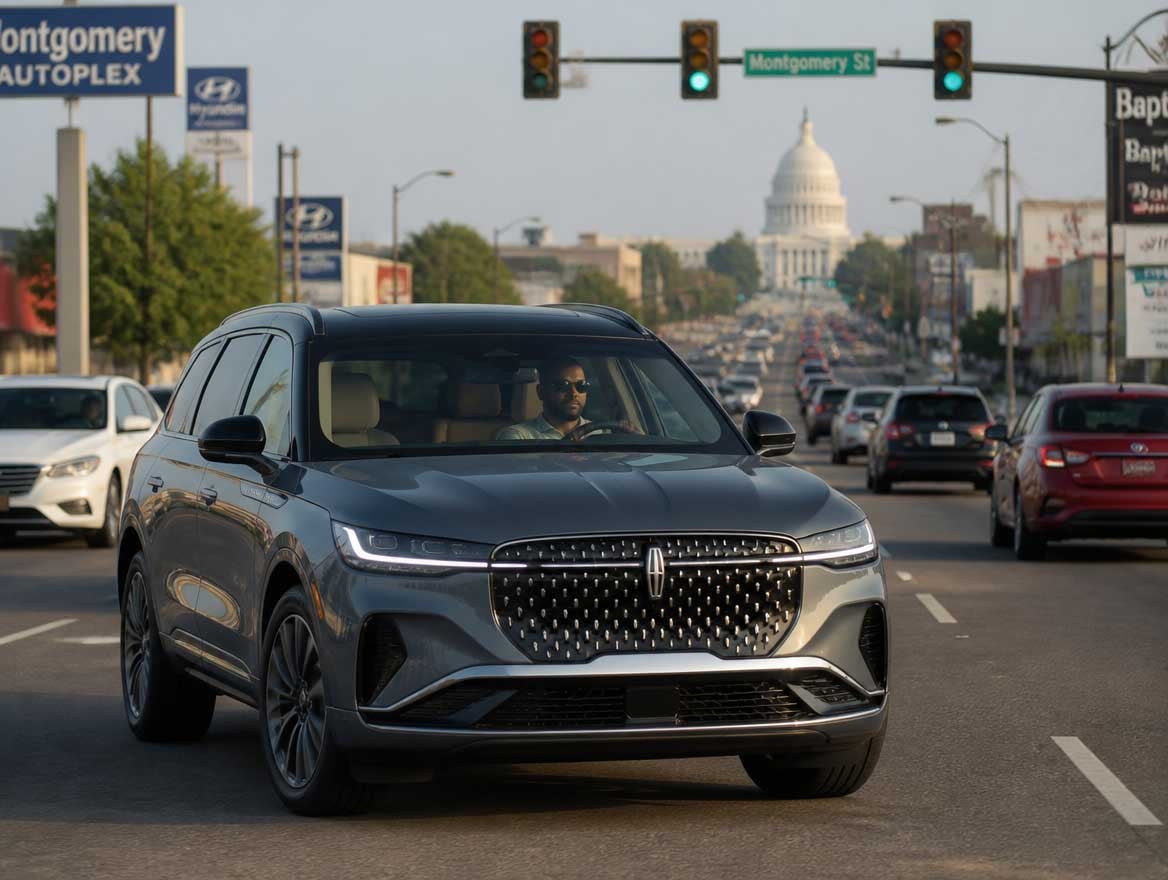
2026 Lincoln Nautilus on Eastern Boulevard in Montgomery AL with Co-Pilot360 active

What Lincoln Co-Pilot360 Can Do on Eastern Boulevard—and What It Can’t

In this article How Does Co-Pilot360 Actually Work? Which Features Actually Matter for This Stretch of Road? A Quick Glossary of Co-Pilot360 Terms What This Means for Your Next Lincoln Eastern Boulevard doesn't forgive much. The road is multi-lane, heavily signalized, thick with commercial cross-traffic, and busy through nearly every hour of the day. It asks plenty of whoever's behind the wheel, luxury badge or not. So when we tell you the Co-Pilot360 suite on the 2026 Lincoln Nautilus and 2026 Lincoln Aviator is genuinely useful on this corridor, we mean something specific. And when we tell you it carries real limits here too, we mean that just as specifically. Co-Pilot360 is a driver-assist suite, not a self-driving system. On Eastern Boulevard it earns its keep in stop-and-go traffic and lane-change moments, but lane-keeping and hands-free BlueCruise depend on conditions that a busy commercial boulevard doesn't always provide. How Does Co-Pilot360 Actually Work? Co-Pilot360 is an umbrella term rather than a single feature, so the useful question is which part you're actually leaning on, because Lincoln's Co-Pilot360 Drive 2.0, standard on every 2026 Nautilus, bundles more than 20 driver-assist features into one suite. They don't all behave the same way, and that distinction matters on a road like Eastern Boulevard. The core layer runs all the time. Pre-Collision Assist with Automatic Emergency Braking uses forward radar and camera to detect vehicles and pedestrians ahead, issuing staged warnings (visual first, then audible, then braking) if you don't respond. Blind Spot Detection with Cross-Traffic Alert monitors your rear quarters through bumper-mounted sensors, lighting a warning in the matching mirror when something's alongside you. Auto High-Beam Headlamps read oncoming light and dim on their own. These systems work on any road, in any traffic, because they're sensing the immediate environment around the vehicle instead of depending on highway infrastructure. The second layer is conditional, leaning on whatever the road gives it. Adaptive Cruise Control with stop-and-go capability is part of Co-Pilot360 Drive 2.0, and it can follow traffic to a complete stop and resume when the car ahead moves. Both help on Eastern Boulevard. The Lane-Keeping System monitors the painted lines and applies gentle steering torque if you drift without a turn signal, and it earns a place here too, within limits we'll explain. Then comes BlueCruise 1.5. Standard on all 2026 Nautilus and 2026 Aviator trims, it delivers hands-free highway driving on pre-mapped Blue Zones, and it operates on 97% of controlled-access highways across the U.S. and Canada, per Lincoln. Eastern Boulevard is not a controlled-access highway. It is not a Blue Zone. BlueCruise doesn't activate here. Co-Pilot360 Feature What it does Works on Eastern Blvd? Where the limit is Pre-Collision Assist with AEB Radar + camera detects vehicles/pedestrians; stages warnings; brakes if needed Yes, always Requires clear sensor view (dirt, mud can obstruct) Blind Spot Detection + Cross-Traffic Alert Rear bumper sensors alert to traffic in blind spots and behind Yes, always Sensor range; trailer towing changes detection zone Lane-Keeping System Camera monitors lane markings; corrects drift without turn signal Yes, when markings are clear Faded paint, construction overlay, poor visibility can disable it Adaptive Cruise with Stop-and-Go Maintains following distance; brakes to a stop; resumes when traffic moves Yes, on multi-lane sections Requires driver engagement in stop-and-go signalized intersections Auto High-Beam Headlamps Dims/brightens based on oncoming traffic and street lighting Yes, at night Has no effect in daylight BlueCruise 1.5 (Hands-Free) Hands-free steering, acceleration, braking; Automatic Lane Change No. Requires Blue Zone mapped highway I-85 east of Eastern Blvd is the closest likely Blue Zone segment Which Features Actually Matter for This Stretch of Road? Eastern Boulevard runs as US-231 and SR-21 through the east side of Montgomery, tying into I-85 and carrying a high volume of lane-change traffic across multiple signals, and three of the Co-Pilot360 features pull genuine weight on it. The rest are fine. These three you'll feel. Blind Spot Detection earns its place on this corridor. Merging from the turn lanes, watching for vehicles accelerating into gaps, backing out of commercial lots, you've got rear bumper sensors that stay active regardless of road type, and the mirror alerts come quick. Back out of a parking area into moving lanes and the Cross-Traffic Alert is the piece doing exactly what it was designed to do. Adaptive Cruise with stop-and-go handles the rhythmic deceleration of signalized traffic well enough that you notice its absence the moment you drive something without it. Set a following distance and the vehicle manages the gap through the slower patches without you riding the brake pedal. Does it replace your judgment at intersections? No. The system isn't built to react to a changing signal, but between signals on the longer multi-lane sections, it trims the fatigue that accumulates across a commute. The Lane-Keeping System works here, with one honest caveat: it reads painted lane markings. Sections of Eastern Boulevard with worn paint, fresh overlay from utility work, or construction restriping will make the system temporarily suspend lane-keeping assist. The instrument cluster tells you when it's off, which is the system flagging boundaries it can't see clearly rather than guessing at them. Worth knowing before you lean on it. Schedule a Service Appointment A Quick Glossary of Co-Pilot360 Terms Term What it actually means Blue Zone A pre-mapped segment of controlled-access highway where BlueCruise hands-free driving can activate Lane Centering Actively steers the vehicle to the center of a lane (part of BlueCruise; separate from Lane-Keeping) Lane-Keeping System Corrects drift at lane edges without centering; works without BlueCruise Automatic Emergency Braking (AEB) The braking action taken by Pre-Collision Assist when the driver hasn't responded to a warning Evasive Steering Assist Supplements steering input if you swerve around an obstacle that AEB can't fully avoid What This Means for Your Next Lincoln If your daily driving centers on Eastern Boulevard and the east-side surface streets, you'll lean on the core Co-Pilot360 features constantly, and you won't touch BlueCruise until you reach a controlled-access highway. I-85 is the natural transition point, and that's where the hands-free Blue Zone is likely to come alive on the 2026 Nautilus and 2026 Aviator. The Navigator carries Co-Pilot360 as well, and for drivers who take long highway runs toward Atlanta or down toward the Gulf Coast, BlueCruise's value compounds quickly on those stretches. On the boulevard itself, though, the story holds across models. The awareness and braking features work everywhere, and they work well. There's one honest tradeoff worth stating plainly, and Co-Pilot360 asks you to stay an attentive, engaged driver, with the driver-facing camera in BlueCruise mode confirming your eyes are on the road. Co-Pilot360 won't drive the car for you, full stop. These systems are aids, real ones, meaningfully tested, and still no substitute for the person behind the wheel. Choosing a Lincoln partly for this technology is a sound reason. Expecting it to remove you from the task of driving is what'll need adjusting before you take delivery. Our team is glad to walk through exactly which features are active in which conditions during a drive on Eastern Boulevard itself. There's a specific satisfaction in pointing out the blind-spot alert firing as a vehicle slides into your quarter panel. It's clearer than any explanation. Frequently Asked Questions Does Co-Pilot360 steer the car for me on Eastern Boulevard? Not autonomously. The Lane-Keeping System applies gentle corrective steering torque if you drift toward a lane line without using a turn signal, but it doesn't continuously steer the vehicle through turns or around obstacles. BlueCruise, which does handle lane centering hands-free, only activates on pre-mapped controlled-access highways called Blue Zones, not on surface roads like Eastern Boulevard. On the boulevard, you're the driver; the system is watching your back. Will BlueCruise work on my way to I-85? BlueCruise activates only within designated Blue Zones on controlled-access highways, and Lincoln reports that those Blue Zones cover 97% of such roads across the U.S. and Canada. Eastern Boulevard itself (US-231/SR-21) is a surface arterial and is not a Blue Zone. Once you access I-85, BlueCruise becomes available on the applicable mapped segments, the instrument cluster illuminates blue to signal the transition. For the surface-road portion of your commute, Co-Pilot360's always-on features (Pre-Collision Assist, Blind Spot Detection, Adaptive Cruise) are the relevant tools. Explore Financing Options Stivers Lincoln of Montgomery 4000 Eastern Blvd, Montgomery, AL 36116 (334) 647-6905

Lincoln Co-Pilot360 2.2

How to Use Lincoln Co-Pilot360 2.2 on 2026 Lincoln SUVs for a Smoother Driving Experience

The 2026 Lincoln SUV lineup brings driver assist technology that genuinely changes how you experience time behind the wheel. Lincoln Co-Pilot360 2.2 Vision represents an advanced optional upgrade in driver assistance, blending sensors, cameras, and software to support your decisions without taking over completely. It comes standard on Nautilus Reserve and Black Label trims, working seamlessly with how you naturally drive. Schedule a test drive at Stivers Lincoln of Montgomery to experience how these features boost both safety and comfort on real Montgomery roads. New Lincoln Inventory UsedLincoln Inventory Get Financing Online Call Us Today Activating Lincoln Co-Pilot360 2.2 Vision on the 2026 Nautilus Getting Lincoln Co-Pilot360 2.2 Vision up and running takes just a few taps on the 11.1-inch center touchscreen. The 48-inch panoramic display across the dashboard keeps you updated with real-time visuals and color-coded graphics showing which driver aid features are active, where you choose which features should run automatically. Your instrument cluster keeps you updated with real-time visuals and color-coded graphics showing which driver aid features are active and what they're tracking around your vehicle. Multiple sensors positioned around the Nautilus collect data about other vehicles, pedestrians, and road markings in split seconds. Small indicators on your dash confirm that cameras and radar have clear sight lines, plus you'll get alerts if weather temporarily blocks their vision. The digital display shows exactly what those sensors detect: vehicles in adjacent lanes, distance from cars ahead, and pedestrians near crosswalks. Most drivers find that after about a week, checking these indicators becomes as automatic as glancing at the speedometer. Highway Driving Confidence with Co-Pilot360 2.2 Vision Those long highway stretches become less draining when Adaptive Cruise Control handles your speed based on traffic flow. The system accelerates and slows smoothly as vehicles ahead change pace, maintaining a safe gap you can adjust using steering wheel buttons. You stay completely in charge here, able to take over instantly by hitting the brake or gas pedal. Lane Keeping System brings another level of support, gently nudging your Nautilus toward center when it spots unintended drifting. The steering wheel gives subtle resistance rather than sharp corrections that might startle you. The system can actually distinguish between deliberate lane changes (when you use your turn signal) and accidental drift, only stepping in when needed. As with all driver-assist features, the Lane Keeping System is a supplement to attentive driving, not a substitute for it. Pre-Collision Assist watches ahead with impressive accuracy, determining whether your current speed and direction might lead to trouble. The technology gives warnings in stages: visual alerts first, then audible warnings, and finally emergency braking if you don't respond. This stepped approach lets you handle situations yourself before the system takes decisive action. These systems are designed to support your awareness on the road, they work best when the driver remains engaged and attentive at all times. Navigating City Traffic with Hands-On Support Stop-and-go traffic becomes significantly less aggravating when your SUV manages that endless cycle of speeding up and slowing down. The system maintains proper following distances while smoothly bringing your Nautilus to complete stops. When traffic starts moving again, just a light touch of the gas reactivates everything without you constantly working the pedal. Those integrated sensors provide invaluable awareness on packed city streets. Pedestrians stepping from between parked cars, cyclists appearing from side streets, and vehicles suddenly switching lanes all show up on your detection network. Visual and audio alerts point out potential problems before they turn dangerous, reducing mental effort and helping you make smarter decisions. The 360-Degree Camera with bird's-eye view makes tight parking spots much easier with multiple viewing angles. The system can identify parallel and perpendicular spaces and provide steering guidance, the driver remains in control of speed and must stay alert and ready to take over at any time. Even skilled drivers appreciate this assistance in cramped garages or along busy streets. Regular maintenance through our service department keeps these sensors properly calibrated for optimal performance. How 2026 Lincoln SUVs Compare in Driver-Assist Technology Lincoln brings driver assist technology to its complete SUV lineup, though features vary considerably by model. Understanding these differences helps you pick the vehicle that truly fits your driving style. Explore our 2026 Lincoln inventory to compare models in person. 2026 Lincoln Corsair: Co-Pilot360 2.1 Features The Corsair delivers driver assistance through its standard Co-Pilot360 2.1 package, including forward collision warning, automatic emergency braking, adaptive cruise control with stop-and-go, lane-centering steering, and a following-distance indicator. The Corsair's compact size makes it especially effective for city driving, where BLIS blind-spot monitoring and standard automatic emergency braking provide added confidence. Families and daily commuters love how these technologies reduce stress during school pickups, shopping trips, and those daily work commutes. 2026 Lincoln Aviator: Standard Co-Pilot360 Drive 2.0 The Aviator steps up capabilities with its standard Co-Pilot360 Drive 2.0 system. This three-row midsize luxury SUV combines family practicality with genuine Lincoln refinement. Lane-centering assist works alongside Adaptive Cruise Control for enhanced highway comfort, with the system maintaining lane position even through curves. Long-distance drivers really appreciate how these connected features reduce fatigue during extended trips, while parents value that extra safety layer for family journeys. All 2026 Aviator models also include four years of Lincoln BlueCruise, enabling hands-free highway driving on designated Blue Zones across North America. 2026 Lincoln Navigator: Co-Pilot360 Drive 2.0 The Navigator showcases Lincoln's driver assistance technology with Co-Pilot360 Drive 2.0. This full-size luxury SUV offers the most comprehensive feature set, including everything from smaller models plus enhanced functions suited to the Navigator's substantial size and power. Standard Co-Pilot360 features like blind-spot monitoring and the surround-view camera system prove particularly useful when towing or positioning this commanding vehicle. Advanced parking assistance becomes crucial when positioning this commanding vehicle in confined spaces. Schedule Your Technology Demo at Stivers Lincoln of Montgomery Experience Lincoln Co-Pilot360 2.2 in person at Stivers Lincoln of Montgomery, where our team provides personalized technology demonstrations on real Montgomery roads including I-85 commutes and downtown traffic scenarios. We'll walk you through setup procedures and answer your questions about how the technology adapts to your specific driving habits. Contact our team at 334-777-6998 or visit us at 4000 Eastern Blvd. to schedule your demonstration and explore financing options for your next Lincoln SUV. Images by OEM

Contact Us

Fill out this form below and we'll contact you shortly
*Required Fields