Blog / Driver Safety

Preparing Your Lincoln for Game-Day Traffic on I-65

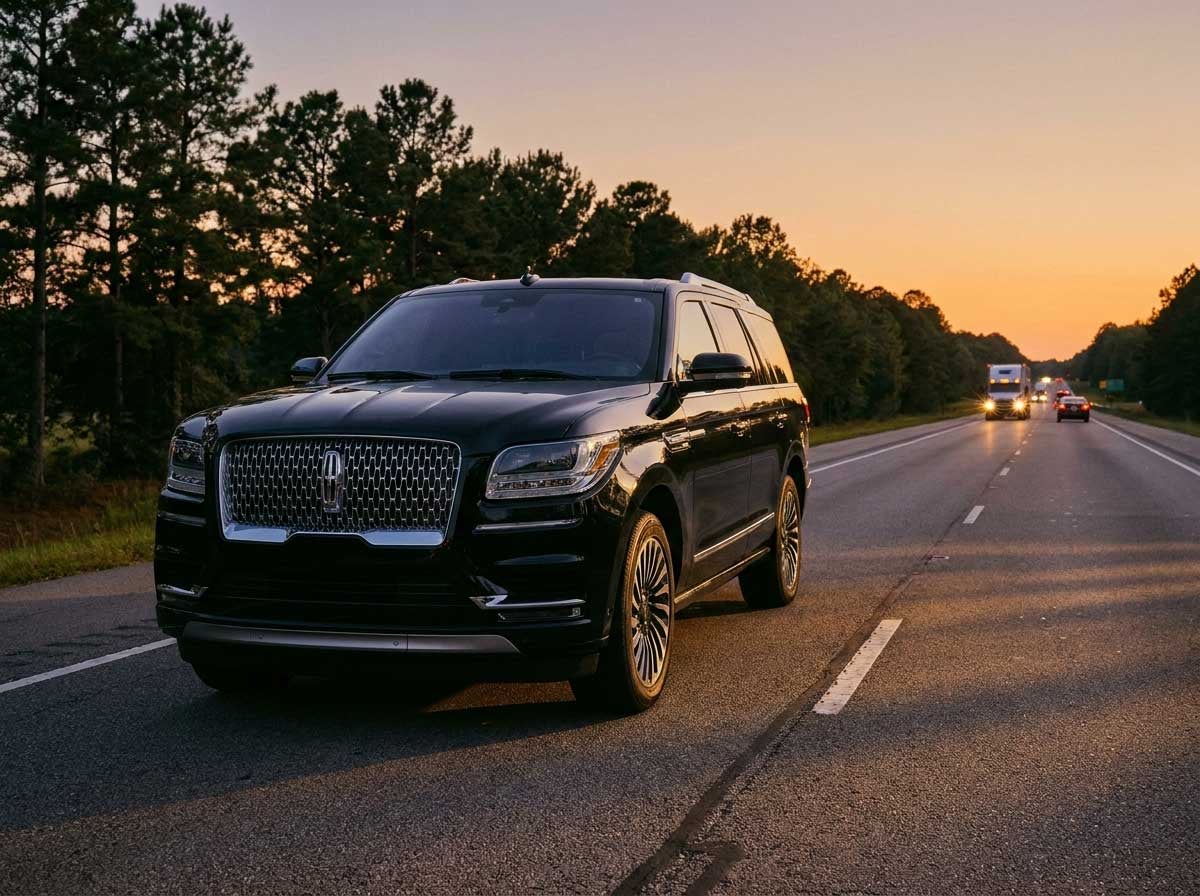
2026 Lincoln Navigator on I-65 in Alabama during game-day traffic at sunset

On any Alabama football Saturday, I-65 north of Montgomery turns into something between a highway and a slow-moving parade. The run from the River Region to Bryant-Denny Stadium in Tuscaloosa covers about 90 miles, and the traffic sorts itself into three phases you can't miss. First there's a congested push through the Montgomery interchange, then a reasonably open mid-highway stretch, then a tightening crawl as Tuscaloosa gets close. Each phase leans on a different set of systems in your Lincoln, and knowing which one does what tells you plenty about which vehicle actually fits your Saturday.

Here's the short answer. Lincoln's BlueCruise and its adaptive cruise tech earn their keep on the open mid-highway segment, not in stop-and-go. Before and after that window, it's the cabin's noise-isolation engineering and climate systems doing the heavier lifting. Pick trims with that in mind.

BlueCruise is a hands-free highway-driving aid that works on designated divided highways (the open I-65 stretch qualifies) and requires an attentive driver at all times. It does not replace your attention. The stadium-area congestion is a different job, handled by Adaptive Cruise Control with Stop-and-Go.

The Lincoln Aviator is a fair place to start this conversation. We'll come back to it.

How Does BlueCruise Actually Work on a Game-Day Drive?

BlueCruise is Lincoln's hands-free driver-assist feature, and it runs only on prequalified divided highways the brand calls Blue Zones, so on this route the open section of I-65 between Montgomery and Tuscaloosa is the stretch where it can actually do its job. What it can't do is manage stop-and-go congestion near the I-65/I-85 interchange in downtown Montgomery or the stadium-adjacent surface streets in Tuscaloosa. Those conditions call on a separate function, Adaptive Cruise Control with Stop-and-Go, which can bring the vehicle to a full stop and resume with traffic.

The three phases of the game-day drive map onto the 2026 Lincoln lineup like this.

Drive PhaseRoad ConditionPrimary Lincoln SystemWhat It Does
Montgomery to interchangeUrban surface and ramp congestionAdaptive Cruise with Stop-and-Go, Pre-Collision AssistMaintains gap to the car ahead through stop-and-go; automatic emergency braking available if traffic stops suddenly
I-65 open highway (roughly miles 70 to 120 northbound)Clear divided interstateBlueCruise (hands-free, Blue Zone)Maintains lane and speed hands-free; driver must remain attentive and ready to resume control
Tuscaloosa approach and campus areaCompressed traffic, one-way restrictions, ALDOT signal managementAdaptive Cruise with Stop-and-Go, 360-degree camera, front/rear parking sensorsLow-speed maneuvering, parking assist, tighter-space confidence
September cabin (all phases)Central Alabama heat; NWS documented heat index values that can exceed 105 degrees in SeptemberDual or quad-zone automatic climate control, ventilated seats, active noise cancellationKeeps the cabin composed while the exterior temperature climbs and engine noise from traffic isolation holds

One tradeoff is worth naming up front. BlueCruise can't be used while towing. If you're pulling a trailer to a tailgate, the system disengages. Plan the trip around that.

Which Lincoln Fits Your Game-Day Group?

The right Lincoln for this run comes down to headcount first and cabin time second, and on a game-day trip those two factors outrank most of the spec sheet, because three hours round-trip in September heat makes ride quality and climate control matter about as much as horsepower does.

Ride quality and cabin environment climb the priority list on a drive this long. A grocery run doesn't test them the same way.

The 2026 Lincoln Nautilus seats five across two rows. Lincoln rates it at 21 MPG city and 29 MPG highway (EPA-estimated, standard 2.0-liter turbo), or 29 city and 31 highway with the available hybrid powertrain. For a couple or a small group, the Nautilus handles the drive efficiently, and the available 48-inch panoramic display doubles as a genuinely capable navigation surface for that congested Tuscaloosa approach. It isn't the vehicle for a group of six or more, though. Worth flagging too, the Reserve and Black Label trims add an adaptive suspension that soaks up highway surface variation noticeably better than the base Premiere does.

For larger groups the picture shifts. The 2026 Lincoln Aviator runs three rows and seats up to seven, with a twin-turbocharged 3.0-liter V6 producing 400 horsepower and 415 lb-ft of torque. Lincoln rates the Aviator at 5,000 pounds of towing capacity when properly equipped. The third row folds flat at the press of a button, so you can reconfigure for cargo on the drive home. On the longer runs, our team notices families settling into the Aviator's second row in particular, since legroom and seat comfort across 90 highway miles read differently than they do in a parking-lot test drive.

When the group is larger still, or when presence at the tailgate counts for as much as the ride, the 2026 Lincoln Navigator moves into a different category. Its twin-turbocharged 3.5-liter V6 produces 440 horsepower and 510 lb-ft of torque. Towing capacity reaches up to 8,700 pounds when properly equipped with the available heavy-duty towing package. BlueCruise is standard across every Navigator trim, and you'll get four years of the Connected Services plan included. EPA-estimated fuel economy for the standard-wheelbase four-wheel-drive Navigator is 15 MPG city and 22 MPG highway.

A Note on September/October Heat and Ventilated Seats

On our lot we see a specific, verifiable pattern hold up. Clients who test Lincoln vehicles in the cooler months and then drive them through August, September, and October tend to reference ventilated seats and multi-zone climate first when they're back. The National Weather Service documented heat index values near 110 degrees in central Alabama this past week. A vehicle that cools an eight-passenger cabin from a 140-degree interior soak to comfortable in under ten minutes is doing engineering work, not adding a luxury flourish. It matters on a three-hour game-day round trip in a way it just doesn't on a grocery run.

The Aviator offers heated and ventilated front and second-row seats. The Navigator adds heated seats across all three rows. Quad-zone automatic climate control is available on both. Rear passengers manage their own temperature independently.

Quick Reference: Game-Day Lincoln Glossary

TermWhat It Actually Means
BlueCruiseLincoln's hands-free highway driver-assist system; operates on prequalified divided highways called Blue Zones; requires an attentive driver at all times
Adaptive Cruise with Stop-and-GoMaintains your following gap from highway speeds down to a full stop and can resume automatically; active in congestion where BlueCruise is not
Active Noise CancellationUses microphones and counter-sound to reduce cabin noise from road surfaces, traffic, and wind; particularly relevant on concrete highway sections with surface variation
Blue ZoneA prequalified segment of divided highway mapped for BlueCruise hands-free operation; most of I-65's open interstate section qualifies

What This Means for Your Next Lincoln

The game-day drive doubles as a useful stress test for any vehicle's technology suite, and it surfaces a distinction that matters back in the showroom, because adaptive cruise with stop-and-go and BlueCruise are complementary systems covering different speed ranges. Both are standard on 2026 Aviator and Navigator models. The Nautilus includes Lincoln Co-Pilot360 with adaptive cruise across all trims, and BlueCruise comes standard on Reserve and Black Label.

If you're choosing between models for this kind of driving, think passenger count first, then cabin environment, then the open-highway segment where BlueCruise earns its keep. The Nautilus handles the trip cleanly for two to five. For a full group, the Aviator earns its place. And when nothing smaller will do, the Navigator is the answer.

We'd be glad to walk through any of these systems in detail at our showroom on Eastern Blvd. To make sure your Lincoln's climate system, adaptive suspension, and driver-assist sensors are working to the standard this kind of driving demands, contact us to schedule a service appointment.

Frequently Asked Questions

Does BlueCruise work in game-day traffic on I-65?

BlueCruise operates on prequalified divided highway segments, and the open stretch of I-65 between Montgomery and Tuscaloosa is within Lincoln's mapped Blue Zone network. It is a driver-assist feature that maintains lane position and speed hands-free, but it is not active in stop-and-go congestion. For the slower, denser traffic near the I-65/I-85 interchange and around the stadium, Adaptive Cruise Control with Stop-and-Go is the relevant system. That function can bring the vehicle to a complete stop and resume with traffic, and it is standard on 2026 Aviator and Navigator models. An attentive driver is required at all times regardless of which system is active.

Which 2026 Lincoln is best for a group game-day trip to Tuscaloosa?

For two to five passengers, the 2026 Lincoln Nautilus manages the drive efficiently, with EPA-estimated fuel economy of 29 MPG city and 31 MPG highway in hybrid form. For groups of six or seven, the 2026 Lincoln Aviator's three-row cabin and 400-horsepower twin-turbocharged V6 give you the combination of space and highway capability the trip calls for. The 2026 Lincoln Navigator is the right answer for larger households or when you need genuine towing capacity alongside full-size seating for up to eight. All three models include Lincoln's BlueCruise-capable driver-assist suite and multi-zone automatic climate control, which matters considerably on a September drive through central Alabama.
Stivers Lincoln of Montgomery

4000 Eastern Blvd, Montgomery, AL 36116

(334) 647-6905

Posted in:

Related Posts

2026 Lincoln Nautilus on Eastern Boulevard in Montgomery AL with Co-Pilot360 active

What Lincoln Co-Pilot360 Can Do on Eastern Boulevard—and What It Can’t

In this article How Does Co-Pilot360 Actually Work? Which Features Actually Matter for This Stretch of Road? A Quick Glossary of Co-Pilot360 Terms What This Means for Your Next Lincoln Eastern Boulevard doesn't forgive much. The road is multi-lane, heavily signalized, thick with commercial cross-traffic, and busy through nearly every hour of the day. It asks plenty of whoever's behind the wheel, luxury badge or not. So when we tell you the Co-Pilot360 suite on the 2026 Lincoln Nautilus and 2026 Lincoln Aviator is genuinely useful on this corridor, we mean something specific. And when we tell you it carries real limits here too, we mean that just as specifically. Co-Pilot360 is a driver-assist suite, not a self-driving system. On Eastern Boulevard it earns its keep in stop-and-go traffic and lane-change moments, but lane-keeping and hands-free BlueCruise depend on conditions that a busy commercial boulevard doesn't always provide. How Does Co-Pilot360 Actually Work? Co-Pilot360 is an umbrella term rather than a single feature, so the useful question is which part you're actually leaning on, because Lincoln's Co-Pilot360 Drive 2.0, standard on every 2026 Nautilus, bundles more than 20 driver-assist features into one suite. They don't all behave the same way, and that distinction matters on a road like Eastern Boulevard. The core layer runs all the time. Pre-Collision Assist with Automatic Emergency Braking uses forward radar and camera to detect vehicles and pedestrians ahead, issuing staged warnings (visual first, then audible, then braking) if you don't respond. Blind Spot Detection with Cross-Traffic Alert monitors your rear quarters through bumper-mounted sensors, lighting a warning in the matching mirror when something's alongside you. Auto High-Beam Headlamps read oncoming light and dim on their own. These systems work on any road, in any traffic, because they're sensing the immediate environment around the vehicle instead of depending on highway infrastructure. The second layer is conditional, leaning on whatever the road gives it. Adaptive Cruise Control with stop-and-go capability is part of Co-Pilot360 Drive 2.0, and it can follow traffic to a complete stop and resume when the car ahead moves. Both help on Eastern Boulevard. The Lane-Keeping System monitors the painted lines and applies gentle steering torque if you drift without a turn signal, and it earns a place here too, within limits we'll explain. Then comes BlueCruise 1.5. Standard on all 2026 Nautilus and 2026 Aviator trims, it delivers hands-free highway driving on pre-mapped Blue Zones, and it operates on 97% of controlled-access highways across the U.S. and Canada, per Lincoln. Eastern Boulevard is not a controlled-access highway. It is not a Blue Zone. BlueCruise doesn't activate here. Co-Pilot360 Feature What it does Works on Eastern Blvd? Where the limit is Pre-Collision Assist with AEB Radar + camera detects vehicles/pedestrians; stages warnings; brakes if needed Yes, always Requires clear sensor view (dirt, mud can obstruct) Blind Spot Detection + Cross-Traffic Alert Rear bumper sensors alert to traffic in blind spots and behind Yes, always Sensor range; trailer towing changes detection zone Lane-Keeping System Camera monitors lane markings; corrects drift without turn signal Yes, when markings are clear Faded paint, construction overlay, poor visibility can disable it Adaptive Cruise with Stop-and-Go Maintains following distance; brakes to a stop; resumes when traffic moves Yes, on multi-lane sections Requires driver engagement in stop-and-go signalized intersections Auto High-Beam Headlamps Dims/brightens based on oncoming traffic and street lighting Yes, at night Has no effect in daylight BlueCruise 1.5 (Hands-Free) Hands-free steering, acceleration, braking; Automatic Lane Change No. Requires Blue Zone mapped highway I-85 east of Eastern Blvd is the closest likely Blue Zone segment Which Features Actually Matter for This Stretch of Road? Eastern Boulevard runs as US-231 and SR-21 through the east side of Montgomery, tying into I-85 and carrying a high volume of lane-change traffic across multiple signals, and three of the Co-Pilot360 features pull genuine weight on it. The rest are fine. These three you'll feel. Blind Spot Detection earns its place on this corridor. Merging from the turn lanes, watching for vehicles accelerating into gaps, backing out of commercial lots, you've got rear bumper sensors that stay active regardless of road type, and the mirror alerts come quick. Back out of a parking area into moving lanes and the Cross-Traffic Alert is the piece doing exactly what it was designed to do. Adaptive Cruise with stop-and-go handles the rhythmic deceleration of signalized traffic well enough that you notice its absence the moment you drive something without it. Set a following distance and the vehicle manages the gap through the slower patches without you riding the brake pedal. Does it replace your judgment at intersections? No. The system isn't built to react to a changing signal, but between signals on the longer multi-lane sections, it trims the fatigue that accumulates across a commute. The Lane-Keeping System works here, with one honest caveat: it reads painted lane markings. Sections of Eastern Boulevard with worn paint, fresh overlay from utility work, or construction restriping will make the system temporarily suspend lane-keeping assist. The instrument cluster tells you when it's off, which is the system flagging boundaries it can't see clearly rather than guessing at them. Worth knowing before you lean on it. Schedule a Service Appointment A Quick Glossary of Co-Pilot360 Terms Term What it actually means Blue Zone A pre-mapped segment of controlled-access highway where BlueCruise hands-free driving can activate Lane Centering Actively steers the vehicle to the center of a lane (part of BlueCruise; separate from Lane-Keeping) Lane-Keeping System Corrects drift at lane edges without centering; works without BlueCruise Automatic Emergency Braking (AEB) The braking action taken by Pre-Collision Assist when the driver hasn't responded to a warning Evasive Steering Assist Supplements steering input if you swerve around an obstacle that AEB can't fully avoid What This Means for Your Next Lincoln If your daily driving centers on Eastern Boulevard and the east-side surface streets, you'll lean on the core Co-Pilot360 features constantly, and you won't touch BlueCruise until you reach a controlled-access highway. I-85 is the natural transition point, and that's where the hands-free Blue Zone is likely to come alive on the 2026 Nautilus and 2026 Aviator. The Navigator carries Co-Pilot360 as well, and for drivers who take long highway runs toward Atlanta or down toward the Gulf Coast, BlueCruise's value compounds quickly on those stretches. On the boulevard itself, though, the story holds across models. The awareness and braking features work everywhere, and they work well. There's one honest tradeoff worth stating plainly, and Co-Pilot360 asks you to stay an attentive, engaged driver, with the driver-facing camera in BlueCruise mode confirming your eyes are on the road. Co-Pilot360 won't drive the car for you, full stop. These systems are aids, real ones, meaningfully tested, and still no substitute for the person behind the wheel. Choosing a Lincoln partly for this technology is a sound reason. Expecting it to remove you from the task of driving is what'll need adjusting before you take delivery. Our team is glad to walk through exactly which features are active in which conditions during a drive on Eastern Boulevard itself. There's a specific satisfaction in pointing out the blind-spot alert firing as a vehicle slides into your quarter panel. It's clearer than any explanation. Frequently Asked Questions Does Co-Pilot360 steer the car for me on Eastern Boulevard? Not autonomously. The Lane-Keeping System applies gentle corrective steering torque if you drift toward a lane line without using a turn signal, but it doesn't continuously steer the vehicle through turns or around obstacles. BlueCruise, which does handle lane centering hands-free, only activates on pre-mapped controlled-access highways called Blue Zones, not on surface roads like Eastern Boulevard. On the boulevard, you're the driver; the system is watching your back. Will BlueCruise work on my way to I-85? BlueCruise activates only within designated Blue Zones on controlled-access highways, and Lincoln reports that those Blue Zones cover 97% of such roads across the U.S. and Canada. Eastern Boulevard itself (US-231/SR-21) is a surface arterial and is not a Blue Zone. Once you access I-85, BlueCruise becomes available on the applicable mapped segments, the instrument cluster illuminates blue to signal the transition. For the surface-road portion of your commute, Co-Pilot360's always-on features (Pre-Collision Assist, Blind Spot Detection, Adaptive Cruise) are the relevant tools. Explore Financing Options Stivers Lincoln of Montgomery 4000 Eastern Blvd, Montgomery, AL 36116 (334) 647-6905

Lincoln Co-Pilot360 2.2

How to Use Lincoln Co-Pilot360 2.2 on 2026 Lincoln SUVs for a Smoother Driving Experience

The 2026 Lincoln SUV lineup brings driver assist technology that genuinely changes how you experience time behind the wheel. Lincoln Co-Pilot360 2.2 Vision represents an advanced optional upgrade in driver assistance, blending sensors, cameras, and software to support your decisions without taking over completely. It comes standard on Nautilus Reserve and Black Label trims, working seamlessly with how you naturally drive. Schedule a test drive at Stivers Lincoln of Montgomery to experience how these features boost both safety and comfort on real Montgomery roads. New Lincoln Inventory UsedLincoln Inventory Get Financing Online Call Us Today Activating Lincoln Co-Pilot360 2.2 Vision on the 2026 Nautilus Getting Lincoln Co-Pilot360 2.2 Vision up and running takes just a few taps on the 11.1-inch center touchscreen. The 48-inch panoramic display across the dashboard keeps you updated with real-time visuals and color-coded graphics showing which driver aid features are active, where you choose which features should run automatically. Your instrument cluster keeps you updated with real-time visuals and color-coded graphics showing which driver aid features are active and what they're tracking around your vehicle. Multiple sensors positioned around the Nautilus collect data about other vehicles, pedestrians, and road markings in split seconds. Small indicators on your dash confirm that cameras and radar have clear sight lines, plus you'll get alerts if weather temporarily blocks their vision. The digital display shows exactly what those sensors detect: vehicles in adjacent lanes, distance from cars ahead, and pedestrians near crosswalks. Most drivers find that after about a week, checking these indicators becomes as automatic as glancing at the speedometer. Highway Driving Confidence with Co-Pilot360 2.2 Vision Those long highway stretches become less draining when Adaptive Cruise Control handles your speed based on traffic flow. The system accelerates and slows smoothly as vehicles ahead change pace, maintaining a safe gap you can adjust using steering wheel buttons. You stay completely in charge here, able to take over instantly by hitting the brake or gas pedal. Lane Keeping System brings another level of support, gently nudging your Nautilus toward center when it spots unintended drifting. The steering wheel gives subtle resistance rather than sharp corrections that might startle you. The system can actually distinguish between deliberate lane changes (when you use your turn signal) and accidental drift, only stepping in when needed. As with all driver-assist features, the Lane Keeping System is a supplement to attentive driving, not a substitute for it. Pre-Collision Assist watches ahead with impressive accuracy, determining whether your current speed and direction might lead to trouble. The technology gives warnings in stages: visual alerts first, then audible warnings, and finally emergency braking if you don't respond. This stepped approach lets you handle situations yourself before the system takes decisive action. These systems are designed to support your awareness on the road, they work best when the driver remains engaged and attentive at all times. Navigating City Traffic with Hands-On Support Stop-and-go traffic becomes significantly less aggravating when your SUV manages that endless cycle of speeding up and slowing down. The system maintains proper following distances while smoothly bringing your Nautilus to complete stops. When traffic starts moving again, just a light touch of the gas reactivates everything without you constantly working the pedal. Those integrated sensors provide invaluable awareness on packed city streets. Pedestrians stepping from between parked cars, cyclists appearing from side streets, and vehicles suddenly switching lanes all show up on your detection network. Visual and audio alerts point out potential problems before they turn dangerous, reducing mental effort and helping you make smarter decisions. The 360-Degree Camera with bird's-eye view makes tight parking spots much easier with multiple viewing angles. The system can identify parallel and perpendicular spaces and provide steering guidance, the driver remains in control of speed and must stay alert and ready to take over at any time. Even skilled drivers appreciate this assistance in cramped garages or along busy streets. Regular maintenance through our service department keeps these sensors properly calibrated for optimal performance. How 2026 Lincoln SUVs Compare in Driver-Assist Technology Lincoln brings driver assist technology to its complete SUV lineup, though features vary considerably by model. Understanding these differences helps you pick the vehicle that truly fits your driving style. Explore our 2026 Lincoln inventory to compare models in person. 2026 Lincoln Corsair: Co-Pilot360 2.1 Features The Corsair delivers driver assistance through its standard Co-Pilot360 2.1 package, including forward collision warning, automatic emergency braking, adaptive cruise control with stop-and-go, lane-centering steering, and a following-distance indicator. The Corsair's compact size makes it especially effective for city driving, where BLIS blind-spot monitoring and standard automatic emergency braking provide added confidence. Families and daily commuters love how these technologies reduce stress during school pickups, shopping trips, and those daily work commutes. 2026 Lincoln Aviator: Standard Co-Pilot360 Drive 2.0 The Aviator steps up capabilities with its standard Co-Pilot360 Drive 2.0 system. This three-row midsize luxury SUV combines family practicality with genuine Lincoln refinement. Lane-centering assist works alongside Adaptive Cruise Control for enhanced highway comfort, with the system maintaining lane position even through curves. Long-distance drivers really appreciate how these connected features reduce fatigue during extended trips, while parents value that extra safety layer for family journeys. All 2026 Aviator models also include four years of Lincoln BlueCruise, enabling hands-free highway driving on designated Blue Zones across North America. 2026 Lincoln Navigator: Co-Pilot360 Drive 2.0 The Navigator showcases Lincoln's driver assistance technology with Co-Pilot360 Drive 2.0. This full-size luxury SUV offers the most comprehensive feature set, including everything from smaller models plus enhanced functions suited to the Navigator's substantial size and power. Standard Co-Pilot360 features like blind-spot monitoring and the surround-view camera system prove particularly useful when towing or positioning this commanding vehicle. Advanced parking assistance becomes crucial when positioning this commanding vehicle in confined spaces. Schedule Your Technology Demo at Stivers Lincoln of Montgomery Experience Lincoln Co-Pilot360 2.2 in person at Stivers Lincoln of Montgomery, where our team provides personalized technology demonstrations on real Montgomery roads including I-85 commutes and downtown traffic scenarios. We'll walk you through setup procedures and answer your questions about how the technology adapts to your specific driving habits. Contact our team at 334-777-6998 or visit us at 4000 Eastern Blvd. to schedule your demonstration and explore financing options for your next Lincoln SUV. Images by OEM

2026 Lincoln Navigator L with Split Gate open on a shaded east Montgomery street

Lincoln Navigator vs. Navigator L: Which Has the Space Your Family Needs?

In this article What's the Real Difference Between the Navigator and Navigator L? Does the Navigator L Change How the Vehicle Drives Day to Day? Passenger Space: Where the Two Models Are Honestly Identical Trim Parity and the Black Label Question So Which Should You Pick? Already set on a 2026 Lincoln Navigator? Then the next question is the one that actually matters, and it's a short one. Standard wheelbase, or long. The answer comes down to a single distinction worth naming plainly. Both cabins feel nearly identical to every passenger on board, and the cargo hold doesn't. The short version Both the Navigator and Navigator L share the same 440-horsepower twin-turbo V-6, the same EPA-estimated fuel economy ratings, the same towing capacity, and similar three-row seating capabilities. The real difference is cargo: the Navigator L adds 14.5 cubic feet of space behind the third row, jumping from 22.9 to 37.4 cubic feet, a 63-percent increase. The Navigator L measures in at 221.9 inches long versus the standard model's 210 inches. That's 11.9 inches of additional length to account for in your garage and on tight parking decks. If your family regularly travels with seven passengers and luggage at the same time, the L earns its keep immediately. If your household is smaller or your commute involves tighter spaces, the standard Navigator is the more practical daily driver. Both are available here at Stivers Lincoln of Montgomery in multiple trims, including the returning Premiere trim for 2026. What's the Real Difference Between the Navigator and Navigator L? Length - specifically, how long the body is after the third row. The Navigator L grows by just under a foot aft of the Navigator's last seat, allowing its cargo volume to increase tremendously. Lincoln builds the Navigator L on a longer wheelbase, 131.5 inches against the standard 122.5 inches, and that additional real estate flows straight into cargo rather than into the room your passengers use. Dimension / Spec 2026 Navigator 2026 Navigator L Overall Length 210.0 in 221.9 in Wheelbase 122.5 in 131.5 in Cargo Volume Behind Row 3 22.9 cu ft 37.4 cu ft Cargo Volume Behind Row 2 69.9 cu ft 84.5 cu ft Max Cargo Volume (Behind Row 1) 107.0 cu ft 121.6 cu ft Engine 3.5L Twin-Turbo V-6 3.5L Twin-Turbo V-6 Horsepower 440 horsepower 440 horsepower Torque 510 lb-ft 510 lb-ft EPA Fuel Economy (city/hwy/combined) 15/22/17 MPG (est.) 15/22/17 MPG (est.) Max Towing (when properly equipped) 8,700 lbs 8,700 lbs Standard Drivetrain 4WD 4WD Lincoln's published figures confirm that passenger volume, shoulder room of 65.3 inches in row one, 65.1 in row two, 64.2 in row three, plus the seat configuration options, are identical between both body styles. A third-row passenger in the L gains no legroom over the standard Navigator. What is gained, however, is room for their belongings to be stashed behind the seat. The Navigator L's 14.5 cubic feet of additional cargo space lives entirely behind the third row. If your family fills all three rows, that's where you'll feel it on every trip. Does the Navigator L Change How the Vehicle Drives Day to Day? Not really. Both vehicles make use of the same 440-horsepower, twin-turbocharged 3.5-liter V-6, and both tip the scales within roughly 100 pounds of each other. You may, however, feel a difference when maneuvering in close quarters, given the Navigator L is nearly 18.5 feet long... Standard residential garages across east Montgomery tend to run generous, yet the multi-deck parking structures downtown or over at Blount Cultural Park can feel snug with that much vehicle. The standard Navigator at 210 inches is hardly small. It simply asks for a little less mental arithmetic when you thread it into a space, and for a daily driver that counts. Towing comes out identical across both models. Lincoln rates both Navigators at up to 8,700 pounds when properly equipped with the available Heavy-Duty Trailer Tow Package, and base capacity without it lands at 6,200 pounds. Put your trailer behind the standard car or the L and the tow spec reads the same either way. "BlueCruise is standard on all 2026 Navigator trim levels, providing hands-free highway driving on more than 130,000 miles of mapped divided highways." (Lincoln) *Driver-assist features are supplemental and require an attentive driver at all times.* Feel free to Explore financing options for either body style before you visit, and our team will walk through the configuration that actually fits your household. Trim Parity and the Black Label Question Both the Navigator and Navigator L come in the same three trims, Premiere, Reserve, and Black Label, and that parity matters more for 2026 than it sounds, because Black Label now reaches the standard-wheelbase model for the first time rather than living on the longer body alone. Previously, Black Label buyers had to step up to the L if they wanted the flagship experience. Now they don't. A household that wants the 30-way adjustable front seats, the heated third-row seats, and the full Black Label interior can pick the standard wheelbase and give up nothing. Space and luxury have become two separate questions. The returning Premiere trim shows up on both bodies as well. Think of it as the way back into the Navigator lineup after a year away, and it arrives standard with the 48-inch panoramic display, a 5G Wi-Fi hotspot, climate-controlled front seats, and the Revel audio system. So Which Should You Pick? Choose the standard Navigator if your household usually rolls with four to six people, if garage depth is a genuine constraint, or if you'd rather have the easier daily driver than the last measure of hauling flexibility, because in town and around the suburbs it threads through space with less fuss. With Black Label now offered in this body style, there's nothing in the luxury stack you have to surrender to get the shorter, handier package. Choose the Navigator L if you regularly carry seven or eight passengers and still need cargo behind all of them. When Lake Martin weekends mean a full SUV with luggage, or when your household travels with adult children and their gear, the 37.4 cubic feet behind row three stops reading as a spec-sheet number and starts being the reason nobody had to hold a bag on their lap. Neither choice is a compromise. They share every meaningful powertrain and technology spec, and the difference lives entirely in the cargo hold. Spatial questions are the ones only you can answer about how your family actually lives. Explore Financing Options We're glad to keep both configurations on hand for a side-by-side look in our showroom at 4000 Eastern Blvd. Reading the numbers and opening both tailgates yourself are two very different things. Frequently Asked Questions Is the third row bigger in the Navigator L than in the standard Navigator? No. The seating dimensions of the third row are essentially the same in both models. What the Navigator L provides is far more cargo space behind that third row: 37.4 cubic feet versus 22.9 cubic feet in the standard Navigator. The length difference lives in the cargo hold, not in the passenger cell. Do the Navigator and Navigator L have different engines or towing capacities? No. Both models share the same 3.5-liter twin-turbocharged V-6 producing 440 horsepower and 510 lb-ft of torque, the same 10-speed SelectShift automatic, and the same 4WD standard drivetrain. Lincoln rates both at up to 8,700 pounds of towing capacity when properly equipped with the available Heavy-Duty Trailer Tow Package. Actual towing capacity varies with configuration, cargo, and the number of passengers. Value Your Current Vehicle Stivers Lincoln of Montgomery 4000 Eastern Blvd, Montgomery, AL 36116 (334) 647-6905