

Lease or buy? It depends on the model and on how you actually use the vehicle, and we'll say that plainly up front. If you're the kind of driver who keeps a car eight or nine years and wants nothing between you and the title, buying wins on total cost. Full stop. But if you replace vehicles every two or three years, leasing is simply less expensive for the same amount of driving time, and in the luxury segment Lincoln's Red Carpet Lease program is structured to make that path genuinely attractive. We've ranked four acquisition paths below, matched to the Lincoln models we carry and the buyer profiles we see at our dealership, from the professional couple who upgrades on a fixed cycle to the senior executive who keeps a flagship for the long run.
We'll be candid about the tradeoff from the start. Leasing always costs more over a long horizon. Two consecutive three-year leases on the same model will generally cost more than purchasing and owning that vehicle outright over the same six years. Leasing is a tool for access and flexibility, not for the cheapest path to a paid-off vehicle.
The Rankings at a Glance
| Rank | Pick | Best For | Standout Spec |
|---|---|---|---|
| 1 | Lease the Nautilus | Professionals who rotate vehicles every 2-3 years | EPA-estimated 29 city / 31 hwy / 30 combined MPG (hybrid AWD) |
| 2 | Buy the Nautilus | Single-vehicle households keeping it 6-plus years | Long-term cost advantage once the loan is retired |
| 3 | Lease the Aviator | Families who want three-row flexibility without a long commitment | Up to 5,000 lbs towing capacity, properly equipped |
| 4 | Buy the Navigator or Navigator L | Executives and larger households who hold flagship vehicles | Up to 8,700 lbs towing capacity, properly equipped |
Rank 1: Lease the Nautilus (Professionals Who Rotate)
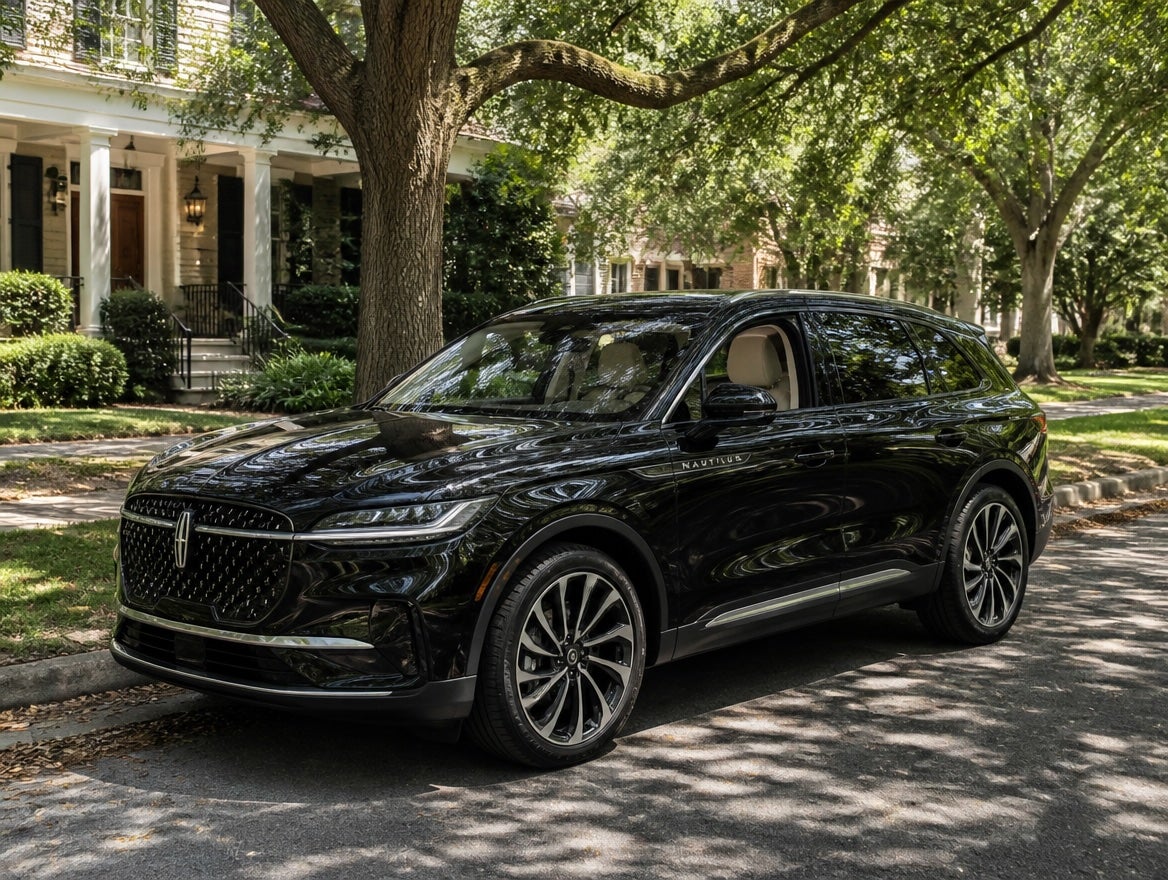
Leasing the Nautilus is the right move for the east Montgomery professional who's simply done carrying a car for a decade, though it'll cost more across a long horizon. If you replace vehicles on a two-to-three-year schedule, leasing the 2026 Lincoln Nautilus gives you the full model, hybrid powertrain included, without front-loading the ownership equation.
The 2026 Nautilus is Lincoln's best-selling model, and the spec sheet earns it. The standard 2.0L turbocharged engine is EPA-estimated at 21 city and 29 highway MPG. Step up to the hybrid AWD configuration and that climbs to EPA-estimated 29 city, 31 highway, and 30 combined MPG, a real number on the Eastern Boulevard-to-I-85 stretch our clients travel daily. Lincoln's Red Carpet Lease program runs the lease. What you're paying each month is the depreciation on the portion you actually use.
Here's the genuine limitation. Most leases set mileage allowances between 10,000 and 15,000 miles per year. If you're running 20,000 miles because you travel to Birmingham or Atlanta regularly, excess-mileage charges at turn-in will apply. Know your number before you sign.
Rank 2: Buy the Nautilus (Long-Term Owners Who Value the Paid-Off Year)
Buying the Nautilus makes the plainest case on this list, and it doesn't ask for a spreadsheet, though it does ask more of you up front. Once the loan is retired, you own a vehicle with no payment. For a client who keeps a Lincoln six, seven, or eight years, those payment-free years are where the total-cost advantage over leasing becomes decisive.
Buying also removes every lease restriction from your life. No mileage cap. No wear-and-tear judgment at turn-in. If you want to take the Nautilus to Lake Martin and back every weekend, then down to the Gulf Coast for the month of July, there's no ledger being kept on how many miles you're adding. You can customize the vehicle, install a hitch for a small trailer, or put a roof rack on it. A leased vehicle isn't yours to modify.
The 2026 Nautilus carries the same EPA-estimated 21 city / 29 highway MPG (standard 2.0L turbo AWD) whether you finance or lease. What changes is the ownership structure at the end of the term.
One honest note here. Buying asks more of you each month than leasing the same vehicle, and you're building toward ownership instead of cycling through access. Ownership has its price.
Rank 3: Lease the Aviator (Families Who Want Three Rows Without the Long Commitment)
Leasing the Aviator fits the family that wants three rows now without committing to a decade of them, and you accept the same mileage ceiling in exchange. The 2026 Aviator is a three-row SUV that seats up to seven. The Aviator tows up to 5,000 lbs when properly equipped with the Class III Trailer Tow Package, enough for a boat or a small trailer. For a family in east Montgomery whose children are still in school now but will be out of the house in four years, leasing the Aviator rather than buying it makes considerable sense. You're not locked into a three-row vehicle when your life may no longer need one.
The 2026 Aviator's 3.0L twin-turbo V6 is EPA-estimated at 17 city and 25 highway MPG (AWD). Power is plentiful and the package around it stays refined. The plug-in hybrid Grand Touring variant delivers 76 MPGe combined on electricity, 33 MPG combined on gas only (EPA-estimated), a very different kind of ownership calculus if charging at home is part of your routine.
Leasing the Aviator carries the same mileage discipline as leasing the Nautilus. This matters more for a family that coaches youth sports, runs multiple school routes, and makes long interstate runs on school breaks. Be realistic about your miles before choosing a term.
- Three-row seating for up to seven people, with genuine refinement in all three rows
- Up to 5,000 lbs towing capacity when properly equipped (Class III package)
- 2026 Aviator AWD: EPA-estimated 17 city / 25 hwy / 20 combined MPG
- Plug-in hybrid (Grand Touring): EPA-estimated 76 MPGe on electricity / 33 MPG on gas only
- Lease flexibility lets you right-size your vehicle when family circumstances change
Rank 4: Buy the Navigator or Navigator L (Executives Who Hold a Flagship)
Buying the Navigator or Navigator L is for a specific kind of client, the one who's decided on a flagship and plans to keep it, and who isn't chasing the lowest monthly number. The Navigator comes standard with a twin-turbocharged 3.5-liter V6 producing 440 horsepower and 510 lb-ft of torque. Equipped with the heavy-duty towing package (standard on Black Label), it tows up to 8,700 lbs. The Navigator L is the long-wheelbase body, the right pick when maximum cargo volume behind the third row actually matters.
These vehicles hold their purpose with quiet authority, and that purpose compounds over time. After a loan is retired, you've got a fully-paid flagship. A lease cycling every 36 months feels different, and the clients who choose this path typically know it going in.
The Navigator carries an EPA-estimated 15 city / 22 highway / 17 combined MPG. It runs on 91-octane fuel or higher. The honest fuel reality of a full-size flagship SUV sits right there, and no number here changes it.
Buying a Navigator also makes sense for clients who entertain, travel with extended family, or regularly carry equipment. No mileage cap means no math, so what you drive stays entirely yours to use however the week demands.
Why Mileage Is the Swing Factor in Montgomery
Annual mileage is the variable that decides the lease-versus-buy question more than anything else on this list, at least for the way our clients actually drive around here. The east-side corridors through Vaughn Road and Taylor Road, combined with regular runs up I-85 toward Auburn or down to the Gulf Coast, can add miles faster than a fixed 12,000-per-year lease assumption accounts for.
Check the odometer on your current vehicle before you talk terms, and pull a year of readings so the number you plan around is real. Our financing team can help you model the right term length for the miles you drive, not the miles you plan to drive in an optimistic moment.
A lease is a legitimate strategy on its own terms. It suits a client who values access over accumulation, who prefers a known monthly cost with no residual-value uncertainty at the end, and who keeps a vehicle inside the mileage band. Buying suits a client who values permanence, wants freedom from restrictions, and keeps vehicles long enough for the paid-off years to matter.
Both are reasonable. The right one depends on the driver, not on which path sounds financially virtuous.