Blog / Lincoln dealership

Taking a Lincoln Aviator to the Montgomery Museum of Fine Arts

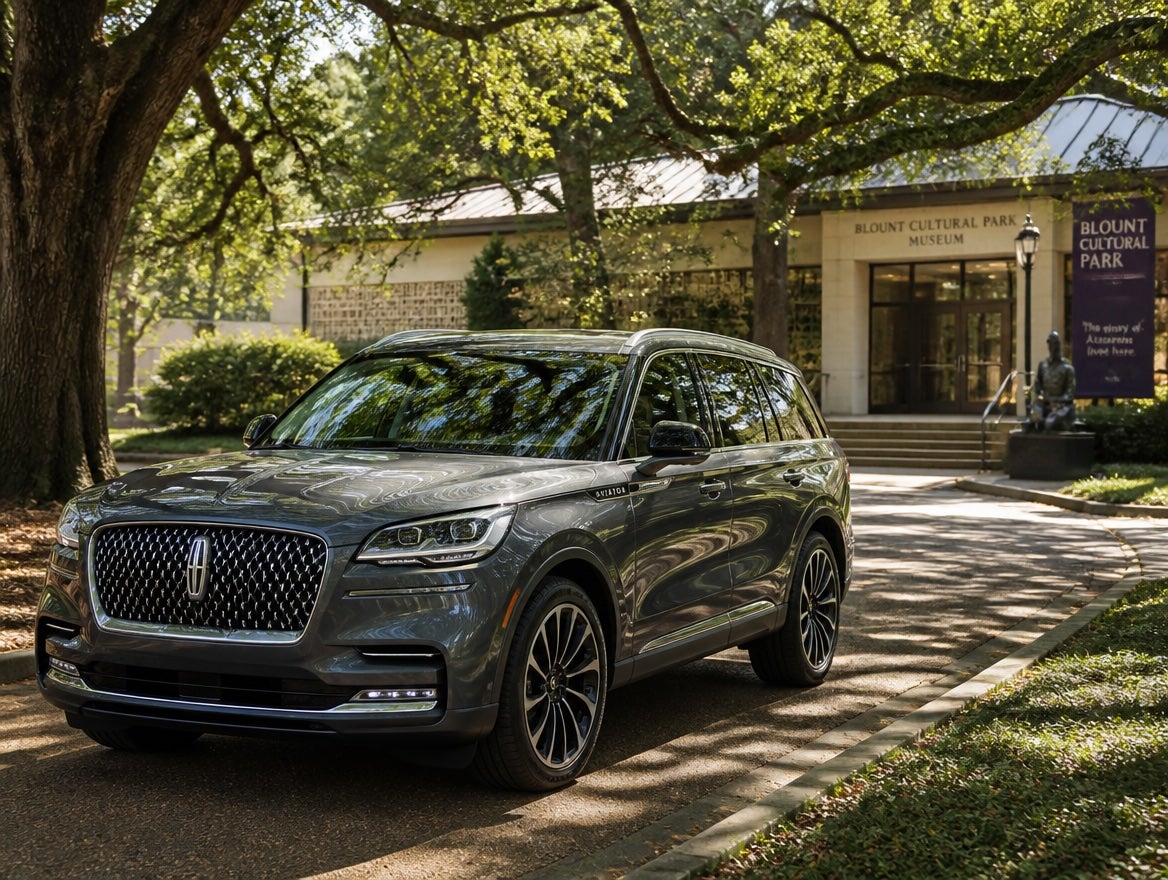
2026 Lincoln Aviator parked in the shade at Blount Cultural Park near the Montgomery Museum of Fine Arts

The Montgomery Museum of Fine Arts sits in Blount Cultural Park, admission is free, parking is free, and the John and Joyce Caddell Sculpture Garden gives you three acres of outdoor art to walk through after the galleries. As afternoons go in east Montgomery, few beat it. Might we suggest heading there in a vehicle that delivers the style, refinement, and comfort best suited for such pursuits? The 2026 Lincoln Aviator three-row SUV is our suggestion for such an artistic pursuit.

The Cabin Stays Cool While the Sculpture Garden Does Not

Montgomery in late September is still summer by any honest measure, and the Aviator's tri-zone automatic climate control, standard on the base Premiere trim, means the cabin you come back to can deliver the cool you left behind while the Sculpture Garden bakes. That's a good thing, considering you'll be walking through the Caddell in genuine heat. Higher Aviator trims add a fourth zone to their automatic climate control systems, which lets whoever's in the second row manage his or her own temperature without negotiating with the front seat. Ventilated front seats are available on Reserve and Black Label trims - that matters more than it sounds after a long walk through outdoor sculpture in Alabama's humidity.

Schedule a Pre-Trip Service Check

Three Rows Mean Nobody Gets Left Behind

The Aviator seats six or seven, depending on configuration, with second-row captain's chairs on most builds and a power-folding third row that drops flat at the touch of a button. That means there's room for pretty much everyone: bring grandchildren to the ArtWorks interactive gallery or parents who want the Sculpture Garden, and everyone rides. Lincoln lists 19.2 cubic feet of cargo space behind the third row, which handles a stroller, a canvas bag, and whatever comes out of the Museum Shop without drama. Fold both rows and you reach 75.9 cubic feet.

Worth knowing:  Third-row legroom measures 29.2 inches, so adults sit back there comfortably for shorter trips, not cross-state ones. For the ten-minute run from the Eastern Boulevard corridor to One Museum Drive, none of that registers.

Also, the Aviator's second-row captain's chairs power tip and slide forward, which opens the path to the third row and makes the climb less of a scramble than most three-row SUVs ask for. On the lot we'll point out that you still want to nudge the front seat forward a touch to clear the widest gap, and older passengers or kids who need a hand notice the difference.

BlueCruise Makes the Drive Part of the Day

Lincoln BlueCruise 1.5 comes standard on every 2026 Aviator trim, including the base Premiere, and on controlled-access highway segments inside designated Blue Zones it runs hands-free across more than 130,000 miles of prequalified divided highway in the United States and Canada, though the last mile into the park is on you. Eastern Boulevard and the Vaughn Road approach into Blount Cultural Park are surface streets, so BlueCruise isn't in play on that stretch. If you're coming in from further out on I-85, it handles the highway leg while the morning is still settling. BlueCruise is a driver-assist feature and requires an attentive driver with eyes on the road at all times.

The 2026 update added automatic lane-change capability and in-lane repositioning, which nudges the vehicle away from adjacent traffic (subtly enough that passengers rarely clock it). It works without fanfare, the way good assistance should.

The Cabin Quiet Sets the Right Tone

The Aviator keeps the drive itself as composed as the galleries you're headed for, using Lincoln's active noise-control engineering to hold wind and road noise down at highway speed, and the available Revel Ultima 28-speaker system on Reserve and Black Label trims rewards the drive over on its own.

Does a quiet cabin actually change a museum visit? A little, and in a way you feel more than measure. Stepping out of road noise into gallery hush is a jolt the Aviator softens before you reach the door.

The Vehicle Fits the Parking Without a Second Thought

Parking at the MMFA is the easy part, because the lot at One Museum Drive is open, surface-level, and free, precisely what a 199.7-inch three-row SUV is built for. Pull in, find a stall, and you're done. The museum is open Tuesday through Saturday from 10 a.m. to 5 p.m. and Sunday from noon to 5 p.m. Mondays it's closed. Last entry is 4:45 p.m.

It's worth confirming your timing before you go, particularly on Sundays. The short hours leave less margin than you'd think.

The Aviator Delivers An Artful Drive

The 2026 Lincoln Aviator's twin-turbocharged 3.0-liter V-6 produces 400 horsepower and 415 lb-ft of torque, and tows up to 5,000 pounds when properly equipped. Still, none of those figures explains why it's a great tool to use on an afternoon spent at the MMFA. Aviator excells because the cabin is composed, the climate control is thorough, the third row fits the whole group, and the drive from Eastern Boulevard to Blount Cultural Park is as short and pleasant as it ought to be. The museum handles the art. The Aviator handles everything else.

If you want to see what's on our lot, or talk through which trim fits the way your family actually uses a vehicle, our team at Stivers Lincoln of Montgomery sits on Eastern Boulevard and is glad to walk through it without any urgency.

By the Stivers Lincoln of Montgomery Team | September 2026
Stivers Lincoln of Montgomery

4000 Eastern Blvd, Montgomery, AL 36116

(334) 647-6905

Posted in:

Related Posts

2023 Lincoln Navigator parked on Dexter Avenue in Montgomery Alabama with the Alabama State Capitol in the background

Lincoln Navigator by Model Year: Which Used Years Are Worth It in Montgomery

Dexter Avenue runs just half a mile. From Court Square at the bottom to the steps of the Alabama State Capitol at the top, it packs in as much history as any half-mile in the country. People who know Montgomery understand you don't rush it. You park with some thought, you give it time, and the vehicle you arrive in ought to feel as composed as the morning around it. Which makes a used Lincoln Navigator a quiet fit. Not because it's showy. Because it isn't. If you're shopping a used fourth-generation Navigator (2018-present), the year you choose matters more than most luxury buyers realize. Our team has watched buyers walk in set on a specific year, and we'll level with you. Some of those years are fine. Some carry a recall history that deserves a real conversation before any money changes hands. We'd tell a friend the same thing. The short version The fourth-generation Navigator launched in 2018 with a full redesign. First-year "teething" problems make 2018 the year to approach most carefully. NHTSA data shows 2019 drew the most owner complaints of any fourth-generation year (68 complaints). Verify any 2019 VIN before buying. A June 2026 NHTSA recall (26V344) covers seat belt pretensioners on all 2018-2022 Navigators. Check whether the recall has been completed on any vehicle you're considering. The 2021-2024 model years represent the sweet spot: the 10-speed transmission issues were sorted, complaint volume dropped sharply, and the cabin refinements landed intact. Every fourth-generation Navigator shares the same twin-turbo 3.5-liter V6 (440 horsepower, 510 lb-ft of torque), so the powertrain itself isn't what changes year to year. The reliability record is. Browse our pre-owned Lincoln inventory to see what's currently available, then come back to this guide for the year-by-year context that makes a used purchase a confident one. Which Navigator Years Are the Sweet Spot? The honest answer is 2021 through 2024, because those four years carry meaningfully fewer NHTSA owner complaints than the first two years of the fourth generation, the 10-speed SelectShift automatic had found its stride, and none of them carry the recall exposure that defines 2018-2022 as a group. The rest of the field needs more homework. The fourth generation breaks down year by year below. Model Year Generation Status NHTSA Complaint Profile Sweet Spot? Key Notes 2018 First year of 4th gen redesign 48 complaints; 141 Technical Service Bulletins Watch closely First-year issues typical of a full redesign; seat belt pretensioner recall (26V344) applies 2019 Early 4th gen 68 complaints (highest in generation) Approach carefully Most owner complaints of any 4th-gen year per NHTSA; recall 26V344 applies 2020 Mid 4th gen 28 complaints Acceptable with VIN check Recall 26V344 applies; windshield wiper arm recall also involved this year 2021 Refined 4th gen 29 complaints Sweet spot begins Sorted powertrain; recall 26V344 applies through this year 2022 Refined 4th gen 20 complaints Strong choice Highest recall count by campaign number (14), but complaint volume fell to 20; recall 26V344 covers through Oct. 2022 production 2023 Refined 4th gen Low complaint volume Top pick Outside the seat belt pretensioner recall window; fifth gen architecture 2024 Refined 4th gen Low complaint volume Top pick Clearest reliability record of recent used inventory A few things to hold in mind as you read this table. NHTSA complaint counts reflect what owners chose to report; they're a directional signal, not a perfect grade. And recall coverage is the more important variable in 2026, for reasons we're about to explain. Does much change inside across these years? Not dramatically. Lincoln's EPA-estimated 15 city / 22 highway fuel economy is consistent across the fourth generation, and the twin-turbo 3.5-liter V6 makes 440 horsepower and 510 lb-ft of torque, the same numbers whether you're looking at a 2021 or a 2024. What you're choosing when you pick a year is reliability history. Pick 2021 or later and you're in much cleaner water. See new Navigator inventory at Stivers Lincoln of Montgomery if a current 2026 is on the table alongside your used search. Which Years Should You Watch Out For? Start with the June 2026 recall, since it shapes how you should read every 2018 through 2022 Navigator on the market; NHTSA campaign 26V344 covers approximately 77,684 Lincoln Navigator SUVs from the 2018 through 2022 model years. The problem is the front seat belt retractor pretensioner, which may inadvertently deploy and lock in place, preventing the belt from retracting or extending normally. Per NHTSA, the propellant inside the pretensioner can degrade when exposed to high-heat environments. Alabama summers run long and hot, and vehicles parked outdoors here see sustained heat that makes this degradation mechanism relevant to the cars we actually see in Montgomery, not a line on a spec sheet. The remedy is free under federal law. But whether the work has been completed on any specific used vehicle is something you verify against the VIN at nhtsa.gov before you agree to anything. Beyond the recall, here is what our team would flag year by year. 2018 had 141 Technical Service Bulletins in its first year on sale, a typical but genuine cost of buying the first model year of any full redesign. TSBs aren't recalls; they're documented fix procedures issued to dealerships. Still, 141 of them in one year tells you something. The seat belt pretensioner recall applies. We'd want a thorough pre-purchase inspection on any 2018. 2019 is the year NHTSA data flags most clearly. Among fourth-generation Navigators from 2017 through 2026, 2019 drew 68 owner complaints, more than any other year in that span per NHTSA records. Powertrain was the most commonly flagged area. The recall applies here too. A 2019 with a clean VIN history and documented recall completion can still make sense, though it asks more due diligence of you than a 2022 or 2023. 2020 is a middle case. Complaint volume dropped to 28. A windshield wiper arm recall (separate from the pretensioner campaign) was associated with this year. The seat belt recall still applies. Verify both. Explore the Navigator L if maximum cargo volume behind the third row is part of what you're solving for. The long-wheelbase body adds 37.4 cubic feet behind the third row compared to the standard model's 22.9, and the same year-by-year framework in this guide applies to the L as well. Before you make an offer: Pull the VIN on any 2018-2022 Navigator at nhtsa.gov and confirm that recall 26V344 (seat belt pretensioner) shows "remedy available" or "completed." Parts and the full remedy under this expanded recall were expected to be available by late 2026. Our service team can complete open recalls; that's worth factoring into any used negotiation. Get a Trade-In Value on Your Current Vehicle Which Year Fits Which Buyer? We like to be direct here, because the right year depends on what you're optimizing for, and the choices split fairly cleanly between a value-minded buy in the 2021 to 2022 range and the cleanest records sitting on the 2023 and 2024 cars. Let's take them in order. If value relative to condition is the priority, a 2021 or 2022 hits a reasonable middle ground. Complaint volume is low, the powertrain runs smoothly, and you'll still find examples with the full suite of refinements Lincoln brought to the interior. Confirm recall 26V344 status on any 2022 built before October 2022. A 2022 built after that date falls outside the pretensioner recall window entirely. If you want the cleanest used option available, a 2023 or 2024 is the straightforward answer. These years sit outside the seat belt pretensioner recall campaign, NHTSA complaint data is thin (which partly reflects newer cars with fewer miles, but also reflects a genuinely more sorted vehicle), and the cabin is the most current expression of the fourth generation before the 2026 redesign. The 2023 and 2024 deliver the same 440-horsepower twin-turbo V6, the same adaptive air suspension, and second-row seats that slide to offer up to 42 inches of legroom. The third row, at 43.5 inches of legroom, is usable by adults rather than a nominal gesture. If you're considering the Navigator L specifically, the same year-by-year logic applies. The L's advantage is rear cargo. At 37.4 cubic feet behind the third row versus 22.9 on the standard wheelbase, the L is for buyers who need the space the family fills on long drives down I-65 to Gulf Shores, or who want the rear comfort for a group making the Dexter Avenue circuit before lunch. One honest tradeoff is worth naming. A used Navigator is not a small vehicle, and its EPA-estimated fuel economy reflects that (15 city, 22 highway). If most of your driving is short city loops, a 2023 or 2024 Nautilus might serve your daily rhythm better, and we'd say so plainly. The Navigator earns its footprint when you're moving people or towing, or when cabin comfort over a long interstate stretch is the reason you're in a Lincoln. Dexter Avenue runs half a mile from Court Square to the Alabama State Capitol, and its 25-mile-per-hour pace is one of the better settings this SUV ever finds. Explore financing options at Stivers Lincoln of Montgomery when you're ready to talk numbers on a used purchase. Frequently Asked Questions What is the best used Lincoln Navigator year to buy? Based on NHTSA complaint data and recall history, the 2021 through 2024 model years are the strongest used options from the fourth generation. The 2023 and 2024 sit outside the seat belt pretensioner recall (NHTSA 26V344) that covers 2018-2022 models, and they carry the lowest complaint volume in the generation. If a 2021 or 2022 fits your budget better, they're solid choices once you've verified recall status on the specific VIN. What is NHTSA recall 26V344, and does it affect all used Navigators? NHTSA recall 26V344, issued in June 2026, covers approximately 77,684 Lincoln Navigator SUVs from the 2018 through 2022 model years. The issue involves the front seat belt retractor pretensioner, which may inadvertently lock in place and prevent the belt from retracting or extending normally. You can verify whether the recall has been completed on a specific vehicle by entering its VIN at nhtsa.gov. Is the Lincoln Navigator L worth buying used over the standard wheelbase? The Navigator L adds cargo space behind the third row from 22.9 cubic feet to 37.4 cubic feet. If you regularly need that additional cargo room or want the extended rear passenger space for a larger household or long highway trips, the L justifies its footprint. The same year-by-year reliability framework applies to both body styles. Have Our Service Team Check Open Recalls Before You Buy Stivers Lincoln of Montgomery 4000 Eastern Blvd, Montgomery, AL 36116 (334) 647-6905

2026 Lincoln Corsair on I-85 in Alabama heading toward Auburn on game day

Lincoln Corsair Game-Day Travel Guide

The 54 miles from Montgomery to Auburn along I-85 North take under an hour on a normal Saturday. On a game day, and before a noon kickoff in particular, that corridor behaves like a completely different road. We'll walk you through how to approach it so the Corsair does what it was built to do, which is make the trip feel composed. The short version is simple. The 2026 Lincoln Corsair is well-suited for this run, but a few deliberate calls before you leave Eastern Boulevard are what separate arriving relaxed from arriving late. They're worth making. In our Montgomery service bays, summer and early fall is the stretch when the A/C works hardest, and a Corsair left buttoned up in direct sun on Eastern Boulevard can take a few minutes to pull the cabin down before it feels right. Get the fans going before you load up. The Game-Day I-85 Corridor: What to Do and What to Skip November in Alabama brings football weather that starts warm and could stay there, and the 2026 Corsair handles it well, but only if you set the cabin up before you leave the driveway instead of fighting the heat later on the highway. Work with the vehicle and the run stays easy. Situation Do This Skip This Cabin before departure Run the A/C 3-5 minutes before you load the vehicle Starting cold with doors open in direct sun; the cabin takes longer to stabilize Ventilated seats Switch them on in the driveway, before you get warm Waiting until you're already uncomfortable on the highway Adaptive cruise on I-85 Use Intelligent Adaptive Cruise Control in stop-and-go traffic for steady spacing Riding the brake manually through construction slowdowns near Tuskegee Cargo packing Load flat, below the rear headrests; 27.6 cubic feet behind the rear seats handles a full cooler and tailgate chairs comfortably Stacking above sight line; rearward visibility matters when you're threading into packed parking areas Grand Touring PHEV charge Charge fully the night before; on a 54-mile round trip the EPA-estimated 27-mile electric range covers a meaningful portion in EV mode Departing with a half-depleted battery and expecting the same efficiency Departure time for a noon kickoff Leave no later than 9:00 a.m.; I-85 congestion compounds quickly after 9:30 Leaving at 10:30 and expecting the normal 51-55 minute run Parking at Jordan-Hare Arrive with a confirmed, pre-purchased pass; campus reserved spots fill before walk-up windows open Counting on day-of availability in the lots closest to the stadium Adaptive Cruise and Lane Assist Are the Technique That Actually Matters The tech that matters most on this run is Lincoln's Co-Pilot360 suite, because game-day I-85 between Shorter and the Auburn exits is long stretches of compressed, accordion-style traffic where a plain cruise-control plan works fine right up until about mile 30. After that, the driver aids start doing quiet work. Past that point, the Co-Pilot360 suite earns its place. Lincoln's Co-Pilot360 2.0 comes standard on every 2026 Corsair trim. It includes Intelligent Adaptive Cruise Control, which reads the vehicle ahead and modulates speed automatically. There's also Pre-Collision Assist with Automatic Emergency Braking, plus a Lane-Keeping System that keeps the Corsair centered in a lane. It matters during the slow, distracted merging you get when 80,000 people are all routing to the same exit. These are driver aids that require your full attention at the wheel. They don't drive the car for you. What they'll do is reduce the cumulative fatigue of a stop-and-go run so you arrive at Jordan-Hare in the same condition you left home. Our team at Stivers Lincoln watches how the Co-Pilot360 suite performs in Alabama driving conditions. You'll find the I-85 corridor to Auburn is the kind of sustained moderate-speed traffic where adaptive cruise earns its keep. Lincoln's Co-Pilot360 2.0, standard on all 2026 Corsair trims, includes Intelligent Adaptive Cruise Control, Automatic Emergency Braking, and a Lane-Keeping System that require an attentive driver at all times. Before you leave: Check that your 13.2-inch SYNC 4 screen has the navigation set to Jordan-Hare Stadium with traffic enabled. Game-day routing suggestions from the live map can save 15-20 minutes versus running the same exit everyone else takes on autopilot. The Return Trip Deserves the Same Preparation The return trip earns the same preparation as the outbound leg, because after a win (and occasionally after a long one) you'll find I-85 South back to Montgomery fills quickly, and the EPA rates the 2026 Corsair FWD at 22 city / 30 highway for the standard 2.0L engine. Plan the drive home the way you planned the drive out. The Grand Touring's 76 MPGe combined rating means the return leg, run on residual charge and highway gasoline mode, stays efficient regardless of how long you idled in post-game traffic. By the time you point south the battery is spent, so you're on gasoline for most of the way home. Fuel up before you leave the east side of Montgomery, not after you're on the approach ramp. Is the plug-in worth it for a run like this? For a predictable, sub-60-mile round trip, the 27-mile EV range genuinely earns its keep, so browse our current Corsair inventory if you've been considering the move to the Grand Touring's plug-in powertrain. And if your trade is sitting in the driveway while you think it over, a trade appraisal takes three minutes online. Value Your Current Vehicle The game-day run to Auburn and back tells you a lot about a vehicle, and the Corsair handles I-85 with the composure the drive deserves. Prepare the cabin, use the tech the way Lincoln designed it, and give yourself plenty of time. Do that, and you'll make an easy morning of it. Schedule a Pre-Trip Service Check Stivers Lincoln of Montgomery 4000 Eastern Blvd, Montgomery, AL 36116 (334) 647-6905

2026 Lincoln Navigator parked at Blount Cultural Park in Montgomery, Alabama, shaded by mature live oaks on a late-afternoon visit

Taking a Lincoln Navigator to Blount Cultural Park

An evening at the Alabama Shakespeare Festival sounds effortless right up until GPS drops you at a locked gate on Eastern Boulevard with curtain twenty minutes out. The 2026 Lincoln Navigator stays composed on any road, but Blount Cultural Park rewards the driver who's settled the route before backing out of the driveway. The play below runs from arrival time to curtain call. Where Do You Park, and When? Arrive early and the park makes sense; arrive late and a full-size SUV turns the interior lanes into a chore. For an evening ASF show, plan to be in the large adjacent lot off Festival Drive about 45 minutes before curtain, enter from Woodmere Boulevard, and the 210-inch Navigator slots into an open pull-through row without drama. The table sorts out the timing and where to put all of it. Arrive by Lot to use Fit / space note Practical tip 45 min before curtain (evening ASF) ASF's large adjacent lot off Festival Drive Open rows, full-size-friendly, free Enter via Woodmere Boulevard, not Eastern Blvd GPS shortcut 30 min before curtain Same lot, but rows begin filling from the theatre end Navigator's 210-inch length fits; pull-through spaces preferred Vaughn Road entrance is an alternate if Woodmere backs up Under 20 min before curtain Overflow along internal park drive Narrower lanes; more maneuvering at 80 inches wide Consider the Vaughn Road entrance, which feeds the interior lot directly MMFA daytime visit MMFA's own lot off Festival Drive Relaxed, rarely congested outside weekend events Admission and parking are free; arrive any time the museum is open Tip (insider parking): The ASF website is blunt about something our team passes along to anyone headed this way. GPS sometimes routes drivers to a gated service road off Eastern Boulevard near the Arbor Station apartments, and that gate doesn't open for patrons. The only working entrances to Wynton M. Blount Cultural Park sit on Woodmere Boulevard and Vaughn Road. Set your destination as "1 Festival Drive" and confirm your directions actually show one of those two street names before you leave east Montgomery. Tip (lot etiquette): The Navigator's standard hands-free power liftgate earns its keep in a shared lot. You can pull a wrap, a program, or a dog leash from the cargo area without swinging a door into the space next to you. Use it. The folks parked beside you will notice. The Maneuvering and Fit Play At 210 inches bumper to bumper, the Navigator is a full-size body, and it fits the park's main lot comfortably when you use pull-through rows or end spaces. What it won't forgive is a hasty turn into a tight interior lane while the park runs concurrent events at both ASF and the MMFA. Under twenty minutes out, you'll be in the overflow lanes along the internal drive, and those are tight for an 80-inch-wide body. There's no graceful way to thread it. The practical move is straightforward enough. For an ASF evening, enter at Woodmere Boulevard, bear right toward the theatre following the brown wooden signs, and aim for the far end of the large adjacent lot where pull-through rows hand you a clean exit after the show. If you're visiting the museum on a weekend afternoon while ASF has something running at the same time, the Vaughn Road entrance feeds a separate section of the park and keeps you clear of the theatre-lot crush. They're different parts of the same 175-acre grounds, not the same parking field. The 2026 Navigator's adaptive suspension and standard 4WD take the park's internal drives and any soft shoulder in stride. Length is what you manage here, not clearance. The Navigator's standard hands-free liftgate and three-zone climate control make event-day loading and cabin comfort genuinely effortless, but the Woodmere Boulevard entrance is the logistical detail that decides whether the evening starts well. Schedule a Pre-Event Service Check A Go-Enjoy-It Checklist Check the route one more time before you leave the driveway. Five minutes now saves twenty minutes of aggravation in the lot. Navigation Set destination to "1 Festival Drive, Montgomery, AL 36117" Confirm your route shows Woodmere Boulevard or Vaughn Road, not Eastern Boulevard as a final turn Note your intended entrance: Woodmere for ASF evening; either for MMFA daytime Cabin comfort (the Navigator handles this itself, but confirm it) Ventilated front seats on for Alabama's fall humidity, which lingers into early evening Three-zone climate set before you park so the cabin is settled when you return Rear climate confirmed for any passengers in rows two or three Cargo and loading Hands-free liftgate working (wave under the rear bumper to test it in the garage) If you're carrying anything for an outdoor portion of the visit, coats or blankets in the cargo area rather than on seats 21.6 cubic feet behind the third row handles a small cooler, stadium seats, and jackets without touching the passenger rows Timing ASF evening curtains: plan to be in the lot 40 to 45 minutes before showtime MMFA: open Tuesday through Saturday, 10 AM to 5 PM, and Sunday noon to 5 PM, closed Mondays The park itself closes at sundown; evening ASF events are the exception, not the standard After the show The main ASF lot exits toward Festival Drive; give it five minutes before joining the queue The Navigator's 5G Wi-Fi hotspot, standard on all 2026 trims, means passengers can settle in while you wait for the lot to clear The Navigator L carries 36 cubic feet behind the third row if you're bringing a larger group with luggage or gear for a full afternoon in the park. Worth noting if you're weighing body styles for this kind of regular east-side use. See What Your Current Vehicle Is Worth Stivers Lincoln of Montgomery 4000 Eastern Blvd, Montgomery, AL 36116 (334) 647-6905